

Daylight saving time (DST) means moving the clocks forward one hour in spring and back one hour in autumn. The idea is to give summer evenings an extra hour of daylight. People remember it as “spring forward, fall back”.
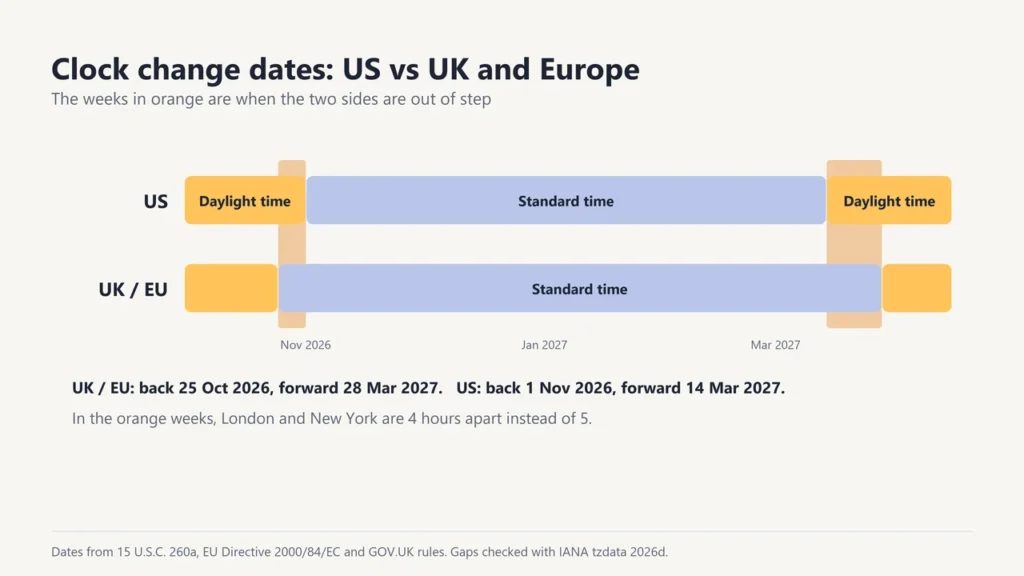
The dates depend on where you live. In the US, DST runs from the second Sunday in March to the first Sunday in November. In the UK and the European Union, it runs from the last Sunday in March to the last Sunday in October. India does not use daylight saving time at all. The next changes are on 25 October 2026 in the UK and Europe, and 1 November 2026 in the US.
- What it is: clocks go forward 1 hour in spring and back 1 hour in autumn
- US: second Sunday in March to first Sunday in November, at 2 a.m. local time
- UK and EU: last Sunday in March to last Sunday in October
- India: no DST; IST stays UTC+5:30 all year
- Does the day get longer? No. Sunrise and sunset just happen an hour later on the clock.
What is daylight saving time?
Daylight saving time is a seasonal change to a region’s clocks. In spring, clocks move forward one hour, so you “lose” an hour of sleep that night. In autumn, they move back one hour, and you “gain” it back. The rest of the year is called standard time.
The change doesn’t add any daylight. As Royal Museums Greenwich explains, it has no effect on the length of the day. It only shifts the clock, so sunrise and sunset appear an hour later. Mornings get darker and evenings get lighter. On the change days themselves, the local day is 23 hours long in spring and 25 hours long in autumn, instead of the usual 24 (see how many seconds are in a day).
The official name in US law is “daylight saving time”, without an “s”. “Daylight savings time” is a common spelling, but it isn’t the legal term. In the UK the same idea is called British Summer Time (BST).
When do the clocks change?
| Region | Clocks go forward | Clocks go back | 2026 | 2027 |
|---|---|---|---|---|
| United States | Second Sunday in March, 2 a.m. | First Sunday in November, 2 a.m. | 8 Mar to 1 Nov | 14 Mar to 7 Nov |
| European Union | Last Sunday in March, 01:00 UTC | Last Sunday in October, 01:00 UTC | 29 Mar to 25 Oct | 28 Mar to 31 Oct |
| United Kingdom | Last Sunday in March, 1 a.m. | Last Sunday in October, 2 a.m. | 29 Mar to 25 Oct | 28 Mar to 31 Oct |
| India | No daylight saving time | — | — | |
Europe changes all at once. The EU directive sets the change at 01:00 Greenwich Mean Time for every member state. So Paris, Berlin and Madrid all switch at the same moment, even though their local clocks show different times. The UK changes at that same moment too, under its own law. In the US, each time zone changes at 2 a.m. local time, so the change sweeps across the country hour by hour.
Clock-change times like 2 a.m. and 01:00 are easy to mix up between 12-hour and 24-hour styles. Our 24-hour clock guide shows how to convert between them.
Which places don’t use daylight saving time?
Many places never change their clocks. According to Royal Museums Greenwich, about 70 countries use some form of daylight saving, mainly in Europe and North America. Near the equator, day length barely changes through the year, so DST offers no benefit there.
- India keeps Indian Standard Time (UTC+5:30) all year.
- In the US, the Department of Transportation lists Hawaii, most of Arizona, American Samoa, Guam, the Northern Mariana Islands, Puerto Rico and the US Virgin Islands as places that do not observe DST. US law lets a state opt out, but a state can’t choose its own dates.
How daylight saving changes the time difference
This is the part that causes missed calls and meetings. When one country changes its clocks and another doesn’t, the gap between them changes too.
- India and the UK: India is 5 hours 30 minutes ahead of the UK in winter, but only 4 hours 30 minutes ahead during British Summer Time.
- India and New York: India is 10 hours 30 minutes ahead in winter, and 9 hours 30 minutes ahead while New York is on daylight time.
- London and New York: usually 5 hours apart, but the US and Europe change on different weekends. From 25 October to 1 November 2026 the gap is only 4 hours, and the same happens from 14 March to 28 March 2027.
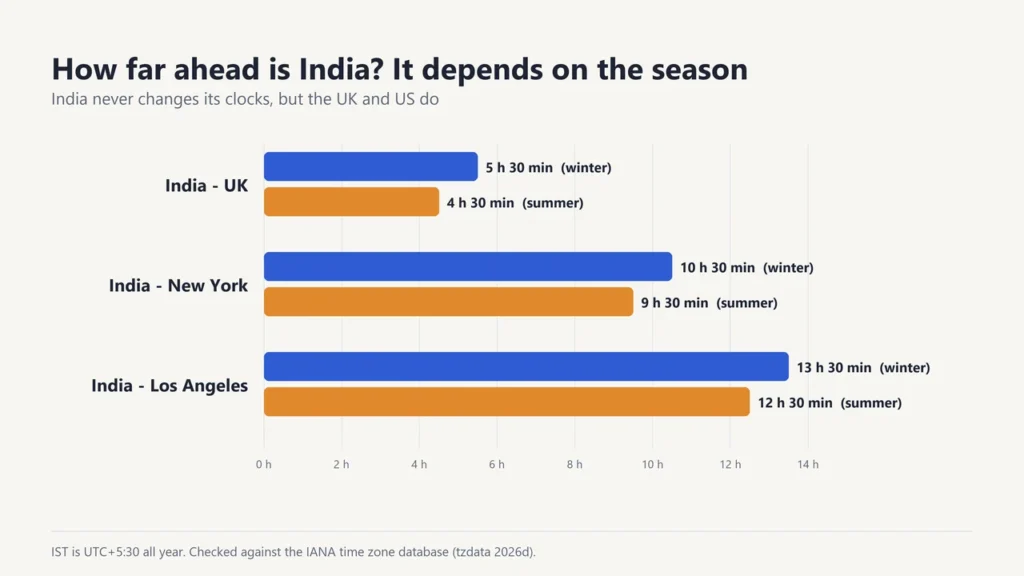
We checked these gaps against the IANA time zone database, the data most phones and computers use. To avoid mistakes, write international meeting times in UTC and let each person convert. Our guides to GMT vs UTC and the ISO 8601 date format explain how.
Why do we have daylight saving time?
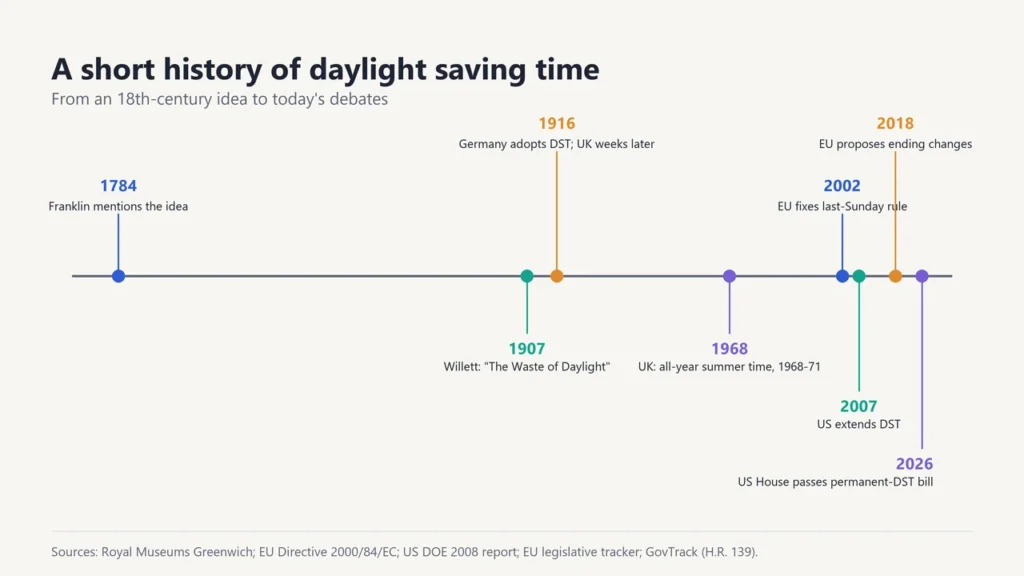
The short answer: to make better use of summer daylight, and originally to save fuel during the First World War. Here is how it happened, according to Royal Museums Greenwich:
- 1784: Benjamin Franklin mentions the idea.
- 1907: William Willett, a British builder, publishes a pamphlet called The Waste of Daylight, proposing that clocks move forward in summer.
- 1916: Germany becomes the first country to adopt daylight saving time. The UK follows a few weeks later, along with many other countries in the war.
- 1968 to 1971: the UK tries keeping its clocks forward all year, then drops the experiment because the pros and cons were too hard to measure.
Does daylight saving time save energy?
A little, but much less than people often think. When the US extended DST by about four weeks in 2007, the Department of Energy studied the effect for Congress. Its 2008 report found electricity savings of about 1.3 terawatt-hours. That was 0.5% per day of extended DST, but only 0.03% of US electricity use over the whole year. If you want to cut your own power use, simple steps at home matter far more. See these ways to lower your electricity bill.
Is daylight saving time bad for your health?
Many sleep experts think the clock changes cause problems. The American Academy of Sleep Medicine (AASM), a US professional body for sleep doctors, published a position statement in 2023 calling for permanent standard time. It says daylight saving time puts the body clock out of step with the sun, and that the twice-yearly switch is linked to health and safety risks. Note that this is a call for permanent standard time, not permanent daylight time.
Is daylight saving time ending?
Not yet. Proposals to stop the clock changes exist in both the US and the EU, but neither has become law as of October 2026.
- United States: the Sunshine Protection Act of 2025 (H.R. 139) would make daylight time permanent. It passed the House of Representatives on 14 July 2026. The Senate version (S. 29) has not passed, so nothing has changed yet.
- European Union: the European Commission proposed ending seasonal clock changes on 12 September 2018. In a public consultation, 84% of 4.6 million responses favoured ending them. The European Parliament backed the plan in March 2019. But Parliament’s own tracker lists the file as blocked by the Council of the EU, which has not agreed a position.
- United Kingdom: the UK left the EU and follows its own law. It still changes its clocks twice a year.
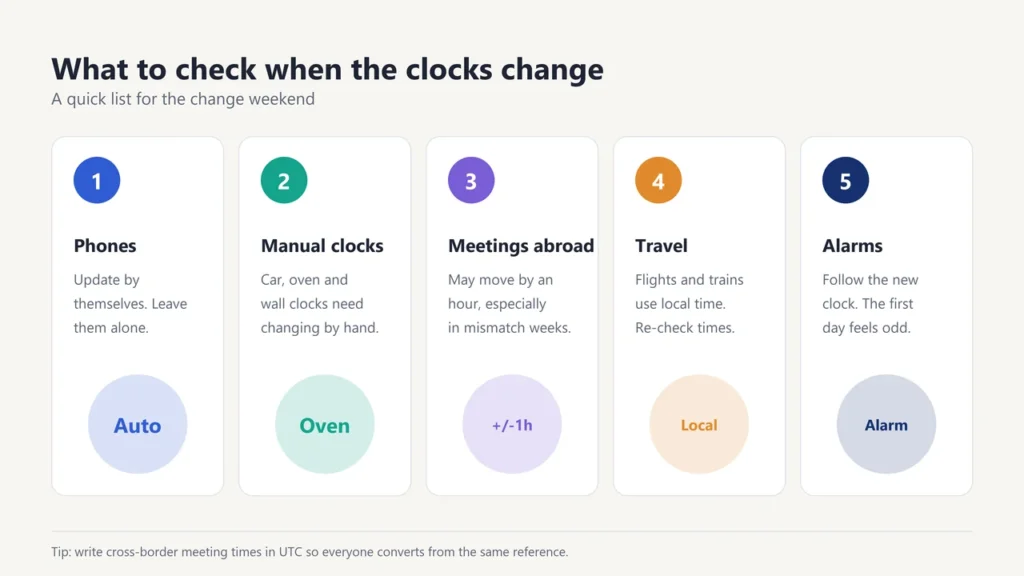
What to check when the clocks change
- Phones and computers update on their own if the time zone is set correctly, so don’t change them by hand.
- Manual clocks such as car, oven and wall clocks need changing yourself.
- Meetings with other countries may shift by an hour, especially in the weeks when the US and Europe are out of step.
- Flights and trains always use local time, so check departures on the change weekend.
- Alarms and medicine times follow the new clock, so the first morning can feel an hour early or late.
Frequently asked questions
When do the clocks go back in 2026?
On Sunday 25 October 2026 in the UK and the EU, and on Sunday 1 November 2026 in the US.
Does India have daylight saving time?
No. India uses Indian Standard Time (UTC+5:30) all year. But the time difference between India and countries that use DST, such as the UK and the US, changes by one hour twice a year.
Do we gain or lose an hour?
You lose an hour in spring, when clocks go forward. You gain an hour in autumn, when clocks go back.
Does UTC change for daylight saving time?
No. UTC never changes. Countries that use DST change their offset from UTC instead. For example, the UK moves from UTC+0 to UTC+1.
Who invented daylight saving time?
William Willett made the first serious proposal in Britain in 1907. Benjamin Franklin had mentioned the idea in 1784. Germany was the first country to adopt it, in 1916.
Is it “daylight saving” or “daylight savings”?
“Daylight saving time” is the official term in US law. “Daylight savings” is a common everyday spelling.

Justwebworld has published guides since 2012. How we write and update articles Report an error
