

Fixed Deposits are popular among investors who prefer stability along with guaranteed returns. They serve as a protective layer in a financial plan. You park your money and know exactly what you will receive when the deposit matures. But opening a Fixed Deposit account without checking the details can affect both your returns and liquidity.
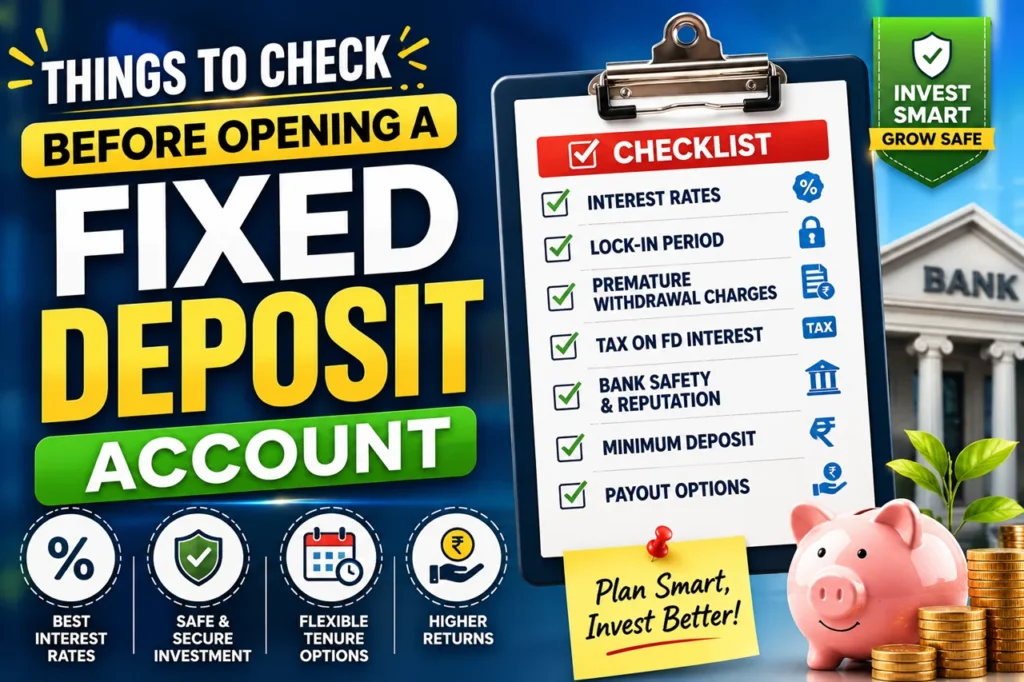
It is important to look beyond just the interest rate. The real benefit comes from understanding how the deposit works and how it aligns with your financial goals. Here are a few key points to check before opening a Fixed Deposit.
What to Look for Before Opening a Fixed Deposit?
Compare Interest Rates Across Banks
Not every bank will offer the same interest rate for the same tenure. You must check and compare across multiple providers. Short-term deposits might give lower rates, while longer-term ones often provide higher returns. Make sure the tenure fits your financial goals and liquidity needs. Also, senior citizens usually receive a slightly higher return.
For example, DCB Bank offers extra interest rate benefits for senior citizens ranging from 0.25% to 0.75% p.a. over regular rates, making it high fixed deposit interest rates for senior citizens.
So, before you open a Fixed Deposit, check the bank’s interest chart. Also, confirm if rates vary for different durations, and not just the amount.
Check the Minimum Deposit Amount and Tenure
Some banks allow you to start with a small amount and others require a higher minimum deposit. It’s important to decide how much to set aside for a period ranging from a few days to ten years. For flexibility and reliable returns, choosing a bank that offers both can be helpful.
Understand the Fixed Deposit Types
Fixed Deposits usually come in two types, these are, cumulative and non-cumulative. Cumulative FDs reinvest the interest along with the principal, that can help the money grow faster through compounding. Non-cumulative FDs pay out interest regularly, which is useful if a monthly income is needed. If regular payouts aren’t required, a cumulative FD is often the better choice.
Pensioners or senior citizens typically opt for non-cumulative option as it provides a steady income stream to cover monthly expenses.
Ask About Premature Withdrawal Rules
Sometimes, a Fixed Deposit may need to be closed early due to emergencies. Most banks allow this but charge a penalty, which can reduce total earnings. The fee usually ranges from 0.5% to 1.5%, depending on how early the deposit is withdrawn.
Before investing, it’s important to check the bank’s early withdrawal policy. Find out if partial withdrawals are allowed or if the entire deposit must be closed. Some banks even offer FDs without a penalty for shorter tenures. For more flexibility, you can consider laddering deposits across different maturity periods.
Can You Get a Loan or Credit Card Against It?
Some banks offer you a loan or a secured credit card based on your Fixed Deposit. This is useful if you want to keep your money invested and still need funds for short-term use.
The interest rate on such loans is usually lower than that of regular personal loans, making it a cost-effective option. This feature is especially helpful during emergencies or planned expenses without breaking the FD. If you wish to access funds without liquidating the deposit, you can choose a bank that offers these options.
| Fixed Deposit Account Checklist | Why It Matters |
|---|---|
| Compare FD Interest Rates | Helps you get higher returns on your investment |
| Check Bank/NBFC Credibility | Ensures your money stays safe and secure |
| Verify Lock-In Period | Important to know how long your money will stay invested |
| Understand Premature Withdrawal Charges | Avoid unexpected penalties if you withdraw early |
| Check Minimum Deposit Amount | Different banks have different FD starting limits |
| Look For Senior Citizen Benefits | Senior citizens often get higher FD interest rates |
| Review Interest Payout Options | Choose monthly, quarterly, or maturity payout as per your needs |
| Understand Tax On FD Interest | FD interest may be taxable under income tax rules |
| Check TDS Rules | Banks may deduct TDS if interest crosses the limit |
| Compare Short-Term vs Long-Term FD | Helps choose the best tenure for your financial goals |
| Verify Auto-Renewal Option | Prevents missed maturity renewal opportunities |
| Check Online FD Facility | Makes FD opening and management easier |
| Understand Compound Interest Benefits | Compounding can increase total maturity amount |
| Review FD Insurance Coverage | Deposit insurance adds extra financial safety |
| Read Terms & Conditions Carefully | Avoid hidden charges or confusing clauses |
| Check Loan Against FD Facility | Useful during financial emergencies |
| Compare Multiple Banks | Helps find the best FD rates and features |
| Confirm Nominee Details | Ensures smooth claim process for family members |
| Check Customer Reviews | Gives insights into service quality and reliability |
| Match FD With Financial Goals | Choose the right FD plan based on your savings target. |
How TDS on FD Interest Affects Your Overall Investment Returns.
Final Thought
A Fixed Deposit is simple to understand, but the options you choose make a big difference. Interest rates matter, but they are not the only thing to be considered. The nature of payout, the length of lock-in and the flexibility in cases of emergencies are also significant aspects that must be looked into.
Banks such as DCB Bank offer Fixed Deposit accounts with a range of tenures, payout options, and features like loans against deposits. By selecting the right FD structure, it’s possible to grow savings efficiently while keeping access to funds when needed.

Justwebworld has published guides since 2012. How we write and update articles Report an error
