

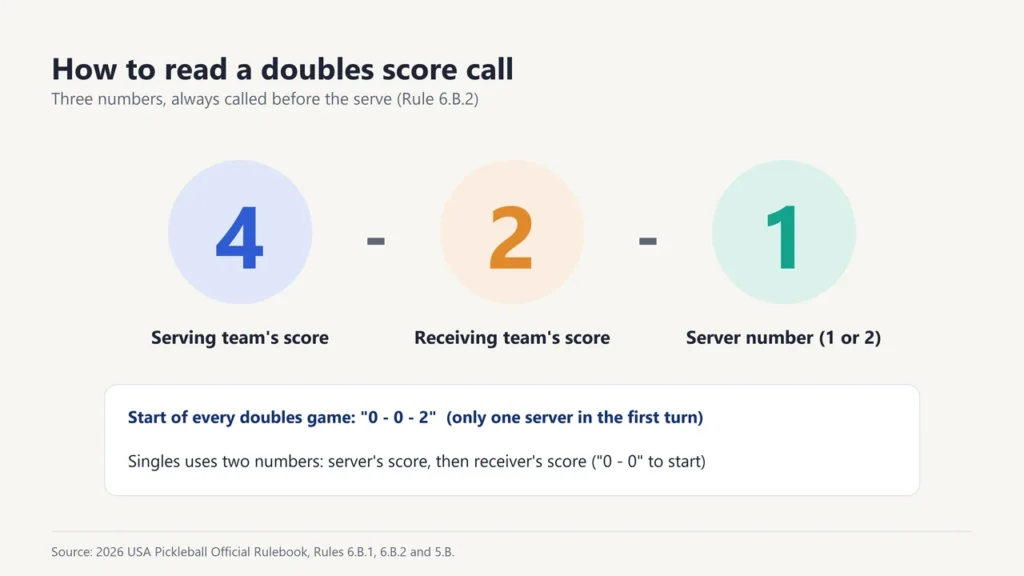
In pickleball, only the serving side can score a point. Games are usually played to 11 points, and you must win by 2. In doubles, the score is called as three numbers: the serving team’s score, the receiving team’s score, and the server number (1 or 2). In singles, it is just two numbers.
This guide follows the 2026 USA Pickleball Official Rulebook, which the Global Pickleball Federation also publishes as its own edition and which Pickleball Canada says Canada and other countries have agreed to follow. Below you’ll find how points work, why every doubles game starts at “0-0-2”, which side to serve from, and a rally-by-rally example you can follow on court.
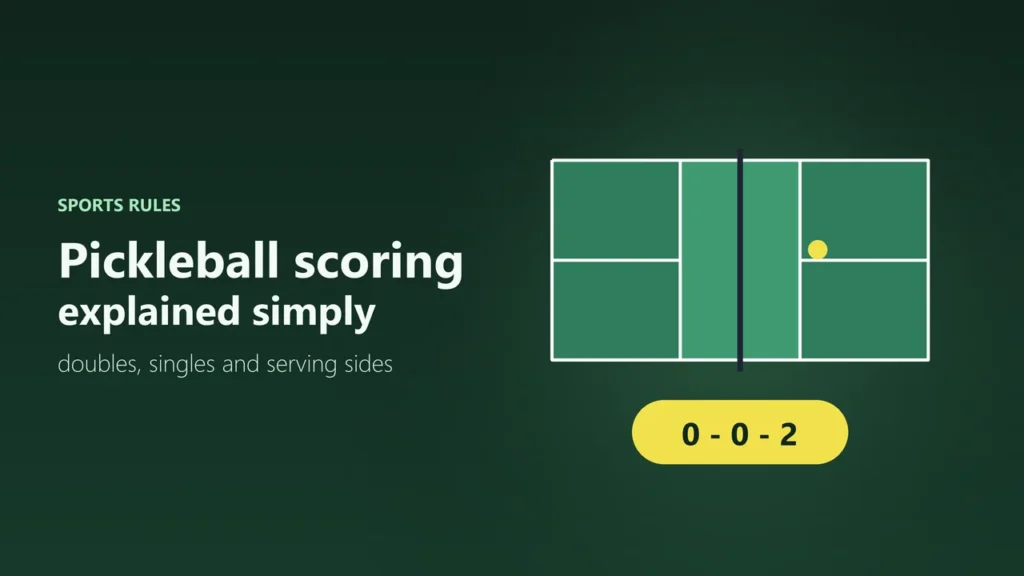
- Who scores: only the serving side (standard scoring)
- Game length: usually to 11, win by 2 (tournaments also use 15 or 21)
- Doubles score call: your score, their score, server number, such as “4-2-1”
- Singles score call: server’s score, then receiver’s score, such as “4-2”
- First serve of a doubles game: called “0-0-2”, and only one player serves
- Where to serve from: right side when the score is even, left side when it is odd
How do you score points in pickleball?
You score a point only when your side is serving and you win the rally. Rule 4.A of the rulebook says a point is scored “by serving the ball and winning the rally”.
If the receiving side wins the rally, nobody gets a point. Instead, the serve moves. In singles, the serve goes straight to the other player. In doubles, it may go to the server’s partner first, and then to the other team. When the serve passes to the other team, it is called a side out.
A rally ends when someone makes a fault. The rulebook defines a fault as a rules violation that ends the rally and loses it. Common faults are:
- Hitting the ball out of bounds
- Hitting the ball into the net
- Letting the ball bounce twice on your side
- Hitting the serve or the return of serve before it bounces (the two-bounce rule)
- A serve that lands in the kitchen or on the kitchen line
What score do you play to in pickleball?
Most games are played to 11 points, and you must win by at least 2. So if the score reaches 10-10, play goes on until one side leads by 2, such as 12-10 or 13-11.
Tournaments use a few set formats. Rule 15.C lists them, and says all of them are win by 2 (team events may allow win by 1):
| Format | Points per game | When to change ends |
|---|---|---|
| Best 2 out of 3 games | 11 | Between games |
| Best 3 out of 5 games | 11 | Between games |
| One game | 15 | When one side reaches 8 |
| One game | 21 | When one side reaches 11 |
| One game (round robins with 6+ teams only) | 11 | When one side reaches 6 |
How to call the score in doubles
In doubles, the score is three numbers, said in this order (Rule 6.B.2):
- The serving team’s score
- The receiving team’s score
- The server number: 1 if this is the first partner to serve in this turn, 2 if it is the second
So “4-2-1” means the serving team has 4, the other team has 2, and the first server is serving. The serving side always says its own score first, so the numbers swap places when the serve changes sides.
Why does a doubles game start at 0-0-2?
To keep the start fair, the team that serves first gets only one server in its first turn. Rule 5.B says that at the start of each game, only the starting server serves, “as a second server”, before a side out. Calling it “0-0-2” shows that this is already the team’s last server.
After that first side out, both partners on each team serve in every turn: server 1 first, then server 2.
Who is server 1?
After each side out, the player standing on the right side (for the team’s current score) serves first and is server 1 for that turn. Their partner is server 2 (Rule 5.B.2). This means server 1 is not always the same person. It depends on where the players are standing when the team gets the serve back.
Which side do you serve from?
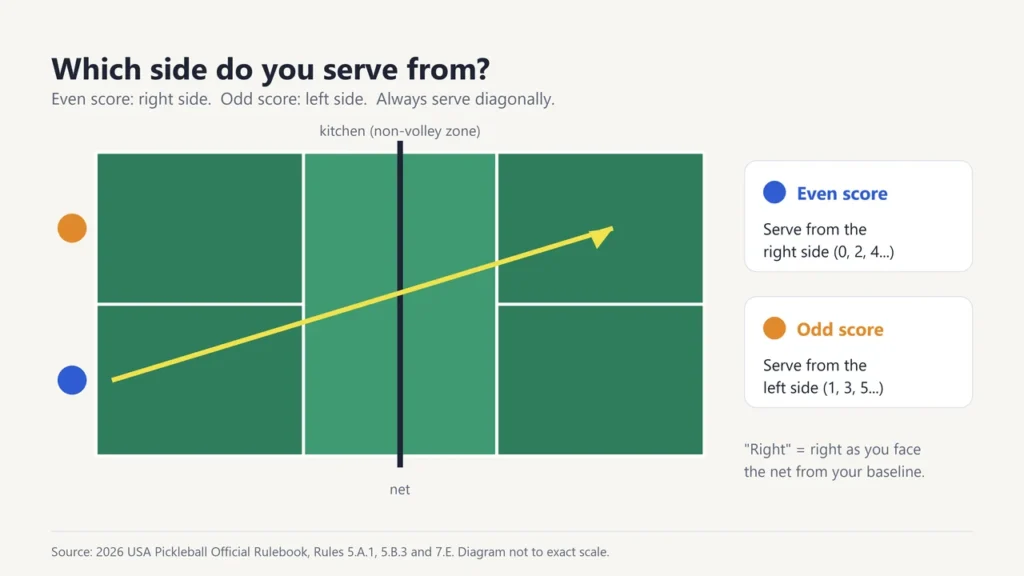
Serve from the right side when the serving side’s score is even (0, 2, 4…) and from the left when it is odd (1, 3, 5…). The serve must go diagonally across the court.
- In singles: it depends on the server’s own score (Rule 5.A.1). Even score, serve from the right. Odd score, serve from the left.
- In doubles: the player who started the game serving stands on the right when the team’s score is even and on the left when it is odd. Their partner stands on the other side (Rule 5.B.3).
- After each point won, the server switches to the other side and serves again (Rules 5.B.5 and 5.B.6). The partner moves across too.
In doubles, players only change sides when their team wins a point on its own serve. Losing a rally does not make anyone switch. That is why, after a side out, server 1 might be either partner.
Doubles scoring example: rally by rally
Here is how the score moves in the first few rallies of a doubles game. Team A (Ana and Ben) serves first. Ana is Team A’s starting server. Team B is Cal and Dee, and Cal is Team B’s starting server.
| Score called | Who serves (from where) | Result | What happens next |
|---|---|---|---|
| 0-0-2 | Ana (right) | Team A wins | Team A scores. Ana moves to the left. |
| 1-0-2 | Ana (left) | Team A loses | Side out. Only one server at the start, so the serve goes to Team B. |
| 0-1-1 | Cal (right, Team B’s score is 0) | Team B loses | No point. The serve passes to Dee. |
| 0-1-2 | Dee (left, where she is standing) | Team B wins | Team B scores. Dee moves to the right. |
| 1-1-2 | Dee (right) | Team B loses | Side out. The serve goes to Team A. |
| 1-1-1 | Ben (right, because Team A’s score is odd and Ana is on the left) | … | Ben is server 1 for this turn. |
Notice the last row. Ben is server 1 because he is standing on the right when Team A gets the serve back. Ana starts on the left because Team A’s score (1) is odd.
How scoring works in singles
Singles is simpler. The score is two numbers: the server’s score, then the receiver’s score. The first call of each game is “0-0” (Rule 6.B.1).
You keep serving, switching between the right and left sides after each point you win, until you lose a rally. Then it is a side out and your opponent serves (Rules 5.A.2 and 5.A.3). Your position always matches your own score: right when it is even, left when it is odd.
Serve and court basics that affect the score
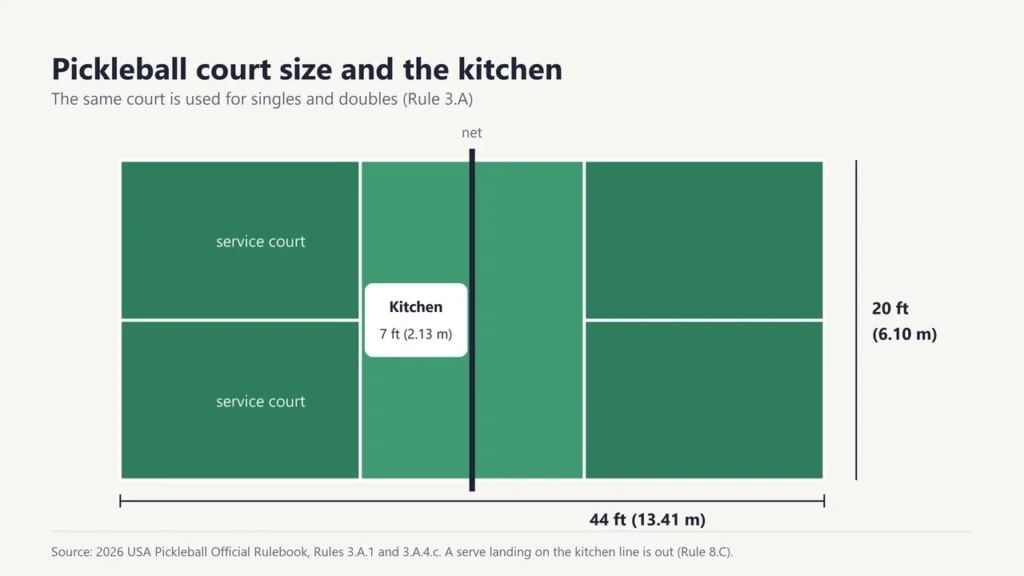
- Where the serve must land: in the service court diagonally opposite, past the kitchen (Rule 7.E). A serve that lands on the kitchen line is out (Rule 8.C).
- Net serves: a serve may touch the net. If it still clears the kitchen and lands in the right court, it is good, and play goes on (Rule 7.E).
- The two-bounce rule: the serve and the return of serve must each bounce before they are hit (Rule 10.A). After that, players may volley.
- The kitchen: officially the non-volley zone. It reaches 7 feet (2.13 m) from the net on each side. The court is 20 feet (6.10 m) wide and 44 feet (13.41 m) long (Rule 3.A).
- Two serve styles: the volley serve (underhand, with an upward arc, ball contact no higher than the waist) and the drop serve (drop the ball and hit it after it bounces) (Rules 7.C and 7.D).
Calling the score: timing and mistakes
The server usually calls the score, and the whole score must be called before the serve is hit (Rule 6.C). The server then has 10 seconds to serve (Rule 6.D).
If someone calls the wrong score, the 2026 rules (6.F to 6.F.4) say:
- Stopped before the return of serve: the rally is replayed with the correct score.
- You stop play, but the score was right: it is a fault against you.
- You stop play after the return of serve: it is a fault against you.
- Nobody noticed until the rally ended: the result stands, and the score is corrected before the next serve.
Before the serve, you can always ask your opponent for the score, and they must tell you (Rule 6.E.1).
What is rally scoring in pickleball?
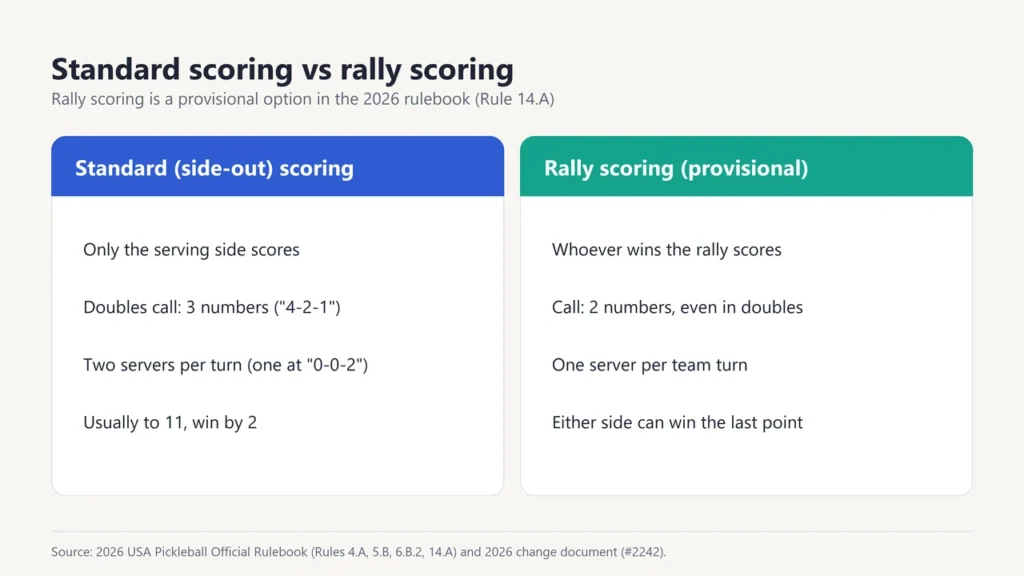
Rally scoring is an optional way to score. A point goes to whoever wins each rally, whether they served or not (Rule 14.A.2). It is still a “provisional” rule in the 2026 rulebook, which means it is allowed but still being tested.
Under rally scoring:
- The score is called as two numbers, even in doubles (Rule 14.A.3).
- Each doubles team has only one server per turn. When the serving team loses a rally, it is a side out (Rule 14.A.5).
- Since 2026, the winning point can be scored by either side. The 2025 rule said game point could only be won while serving. The 2026 change document lists this change as number 2242.
- Tournaments may use it, but not for double-elimination doubles events, 2026 Golden Ticket events or the 2026 USA Pickleball National Championships (Rule 15.C.2).
Time-outs and changing ends
Each player (singles) or team (doubles) gets two time-outs in a game to 11 or 15, and three in a game to 21. Each lasts up to one minute (Rules 21.A and 21.A.5). Calling a time-out after the serve has been hit is a fault (Rule 21.A.2.a).
In a one-game match or a deciding game to 11, players change ends when one side reaches 6. The server stays the same after the change (Rules 21.B.1 and 21.B.4). In a best-of-three match, players also switch ends between games.
Common scoring mistakes beginners make
- Giving the receiving team a point. In standard scoring, winning a rally you didn’t serve only wins you the serve.
- Starting at “0-0-1”. The first call of a doubles game is “0-0-2”.
- Saying the scores in the wrong order. The serving side’s score always comes first.
- Switching sides after losing a rally. Partners only switch when they win a point on their own serve.
- Thinking server 1 is always the same player. It is whoever is on the right when your team gets the serve back.
New to the game? Read our tips for playing pickleball for the first time. If you also play other racket sports, see how tennis scoring works and what equipment you need for table tennis.
Frequently asked questions
Can you score a point when you are not serving in pickleball?
Not in standard scoring. Only the serving side scores. If you win a rally while receiving, you win the serve (or move closer to it in doubles). In the optional rally scoring format, any side that wins a rally scores.
What does 0-0-2 mean in pickleball?
It is the first score call of a doubles game: 0 for the serving team, 0 for the receivers, and “2” because the first serving team gets only one server in its first turn.
Do you have to win by 2 in pickleball?
Yes, in normal play and in tournaments. A game to 11 goes on past 11 until one side leads by 2. Some team events may allow win by 1.
How do you know which side to serve from?
Look at the serving side’s score. Even (including 0) means serve from the right. Odd means serve from the left.
What happens if the wrong score is called?
If a player stops play before the return of serve, the rally is replayed with the right score. If the score was actually correct, or play is stopped after the return, it is a fault against the player who stopped it. If nobody notices until the rally ends, the result stands.
How many points is a pickleball game?
Usually 11 points, win by 2. Tournaments may also play single games to 15 or 21 points.
Is a serve that touches the net a let in pickleball?
No. Under the current rules, a serve can touch the net. If it clears the kitchen and lands in the correct service court, it stays in play.

Justwebworld has published guides since 2012. How we write and update articles Report an error
