

Animals that start with L include the only cat that lives in groups, a primate found on just one island, and a mollusc with the strongest biological material ever measured. Lions, leopards, lemurs, llamas, lynxes, lobsters and lizards are all here.
This guide covers 37 animals beginning with L, with scientific names, animal group, where each lives and what makes it distinctive.
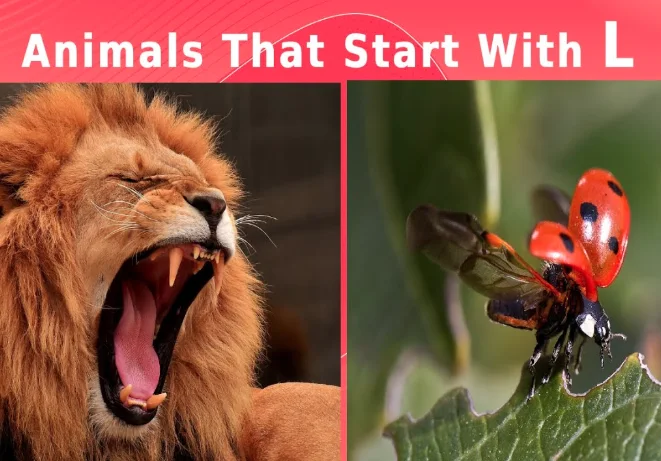
Animals Starting With L: Complete List
| Animal | Scientific Name | Group | Where It Lives | Notable For |
|---|---|---|---|---|
| Labahoula | Canis lupus familiaris | Mammal | Domesticated | Labrador and bloodhound cross |
| Labmaraner | Canis lupus familiaris | Mammal | Domesticated | Labrador and Weimaraner cross |
| Labout’s Fairy Wrasse | Cirrhilabrus laboutei | Fish | Coral Sea | Vivid reef wrasse; males display colour |
| Labrabull | Canis lupus familiaris | Mammal | Domesticated | Labrador and pit bull terrier cross |
| Labradane | Canis lupus familiaris | Mammal | Domesticated | Labrador and Great Dane cross |
| Labradoodle | Canis lupus familiaris | Mammal | Australia | Bred 1989 as a low-shed guide dog |
| Lace Bug | Tingidae | Insect | Worldwide | Lacy wing pattern; feeds on leaf underside |
| Lace Monitor | Varanus varius | Reptile | Eastern Australia | Large climbing goanna |
| Ladybug | Coccinellidae | Insect | Worldwide | Eats aphids; bleeds toxin when threatened |
| Lion | Panthera leo | Mammal | Africa, Gir Forest India | Only truly social cat |
| Leopard | Panthera pardus | Mammal | Africa, Asia | Hauls kills into trees |
| Lemur | Lemuroidea | Mammal | Madagascar | Found nowhere else on earth |
| Llama | Lama glama | Mammal | Andes | Domesticated pack animal; spits to settle rank |
| Lynx | Lynx spp. | Mammal | N. hemisphere | Ear tufts; huge paws act as snowshoes |
| Lizard | Lacertilia | Reptile | Worldwide | Over 7,000 species; many shed the tail |
| Lobster | Nephropidae | Crustacean | Cold oceans | Chews with its stomach; grows for decades |
| Lamprey | Petromyzontiformes | Fish | N. & S. hemisphere | Jawless; sucker disc of rasping teeth |
| Lungfish | Dipnoi | Fish | Africa, S. America, Australia | Breathes air; survives drought in mud |
| Lark | Alaudidae | Bird | Worldwide | Sings in sustained song flight |
| Lyrebird | Menura | Bird | Australia | Mimics chainsaws, shutters and other birds |
| Lorikeet | Loriini | Bird | Australasia | Brush-tipped tongue for nectar |
| Lapwing | Vanellus spp. | Bird | Eurasia, Africa | Feigns a broken wing to lure predators |
| Lammergeier | Gypaetus barbatus | Bird | Mountains, Eurasia & Africa | Drops bones on rock to reach marrow |
| Long-eared Owl | Asio otus | Bird | N. hemisphere | Ear tufts are display, not ears |
| Leech | Hirudinea | Annelid | Fresh water worldwide | Anticoagulant used in modern surgery |
| Lemming | Lemmini | Mammal | Arctic tundra | Mass-suicide story was staged for film |
| Limpet | Patellogastropoda | Mollusc | Rocky shores | Teeth are the strongest known biomaterial |
| Lionfish | Pterois spp. | Fish | Indo-Pacific; invasive Atlantic | Venomous spines — painful sting |
| Locust | Acrididae | Insect | Africa, Asia, Australia | Grasshoppers that swarm when crowded |
| Loris | Lorisidae | Mammal | South & SE Asia | Slow loris is a venomous primate |
| Leafcutter Ant | Atta / Acromyrmex | Insect | The Americas | Farms fungus on cut leaves |
| Leopard Seal | Hydrurga leptonyx | Mammal | Antarctic | Apex predator — dangerous |
| Leatherback Turtle | Dermochelys coriacea | Reptile | All oceans | Largest turtle; leathery not hard shell |
| Lemon Shark | Negaprion brevirostris | Fish | Atlantic, E. Pacific | Yellow tint; studied for social behaviour |
| Langur | Presbytis and allies | Mammal | South & SE Asia | Leaf-eating monkey with a chambered stomach |
| Lechwe | Kobus leche | Mammal | Southern Africa | Wetland antelope; runs through water |
| Lynx Spider | Oxyopidae | Arachnid | Worldwide | Hunts by leaping; no web |
Big Cats and Mammals
Lion
The only genuinely social cat, living in prides built around related females while males come and go in coalitions. Lionesses do most of the hunting and hunt cooperatively; males defend territory, and a male’s mane signals condition and absorbs damage in fights. A roar carries around eight kilometres. Beyond Africa a small population of Asiatic lions survives in the Gir Forest of India, the last remnant of a range that once reached Greece.
Leopard
The most adaptable big cat, surviving from rainforest to desert to the edges of cities, and the most widely distributed. It routinely hauls kills heavier than itself into trees to keep them from lions and hyenas — a display of strength unmatched among cats. Black panthers are melanistic leopards; in strong light the rosettes are still visible under the black.
Lemur
Lemurs live only on Madagascar, having arrived on floating vegetation tens of millions of years ago and diversified in isolation into around a hundred species. Many are female-dominant, which is rare among mammals. Ring-tailed males engage in “stink fights”, rubbing scent from wrist glands onto the tail and wafting it at rivals. They are among the most threatened groups of mammals on earth.
Llama
Domesticated in the Andes some 4,000 years ago as a pack animal, and still used where vehicles cannot go. Spitting is mostly directed at other llamas to settle rank rather than at people. Llamas are protective enough of a herd that they are widely used as livestock guardians for sheep and goats.
Lynx
Four species across the northern hemisphere, all with ear tufts and disproportionately large paws that spread like snowshoes over deep snow. The Canada lynx is so dependent on the snowshoe hare that its population rises and falls on roughly a ten-year cycle following its prey — one of the classic documented predator-prey oscillations in ecology.
Loris
Slow lorises are among the very few venomous mammals. They produce a secretion from a gland on the upper arm which, combined with saliva, becomes a toxin capable of causing anaphylaxis in humans. Their large eyes suit nocturnal life, and that appeal has driven a damaging illegal pet trade in which the teeth are often cut out.
Langur
Leaf-eating monkeys with a chambered stomach and gut bacteria that ferment cellulose, much like a cow — which lets them live on foliage too tough and toxic for most primates. The Hanuman langur is sacred in Hinduism and lives freely around temples and towns across India.
Lechwe
An antelope of southern African floodplains with elongated, splayed hooves and a water-repellent coating on the legs, adapted to run through knee-deep water where predators cannot follow at speed. It grazes on grasses that grow in seasonally flooded ground.
Lemming
Lemmings do not commit mass suicide. The myth was manufactured for a 1958 Disney documentary in which the animals were driven off a cliff by the film crew. What is real is a dramatic boom-and-bust population cycle, and dispersal across water during peak years, which occasionally drowns individuals.
Leopard Seal
The apex predator of Antarctic waters after the orca, with an enormous gape and long recurved teeth. It hunts penguins and other seals.
Caution: leopard seals are among the few marine mammals that have attacked humans, including a fatal incident involving a researcher who was pulled underwater in 2003. They are curious and powerful and should be given a wide margin on ice and in the water — they are not an animal to approach for a photograph.
Birds
Lyrebird
The superb lyrebird is the most accomplished vocal mimic known. It reproduces not only other birds but chainsaws, camera shutters, car alarms and human speech, and the mimicry is learned socially — some populations pass down sounds long after the original source has gone. Males display an elaborate tail while singing from a built mound.
Lammergeier
The bearded vulture lives almost entirely on bone marrow, which is close to unique among vertebrates. It carries bones aloft and drops them onto rock to shatter them, a technique young birds take years to master. Its stomach acid is strong enough to dissolve bone fragments outright. The rust colour on its chest is deliberate — it bathes in iron-rich mud.
Lapwing
Best known for distraction display: a parent will feign a broken wing and stagger away from the nest, drawing a predator after apparently easy prey before flying off once far enough. The tumbling display flight and wheezing call give it the alternative name peewit.
Lark
Larks sing during sustained song flight, climbing and hovering for minutes at a time — the skylark can hold it for over half an hour. The song is a continuous, highly varied stream rather than repeated phrases, and it has anchored more English poetry than almost any other bird.
Long-eared Owl
The prominent “ears” are feather tufts used for display and camouflage, not ears at all — the actual ear openings are asymmetrically placed on the sides of the skull. When alarmed the bird stretches thin and upright against a trunk, and the streaked plumage makes it remarkably hard to see.
Lorikeet
Nectar specialists with a brush-tipped tongue covered in papillae that mop up nectar and pollen. Because their diet is liquid and sugary they are messy feeders and produce very loose droppings, which is why they are demanding as captive birds despite their colour.
Marine and Freshwater Life
Lobster
Lobsters chew with their stomach, using three grinding teeth in a structure called the gastric mill. They keep growing and moulting throughout life, and show negligible senescence — they do not weaken with age in the way most animals do — though moulting becomes increasingly costly and eventually fatal. Their blood is blue, and the familiar red only appears on cooking, when heat unfolds the protein masking the red pigment.
Lamprey
A jawless fish and one of the oldest surviving vertebrate lineages, essentially unchanged for over 300 million years. The mouth is a suction disc ringed with rasping teeth; parasitic species attach to fish and feed on blood and tissue. Sea lampreys devastated the Great Lakes fishery after gaining access through shipping canals.
Lungfish
Lungfish breathe air with true lungs and are more closely related to land vertebrates than to most fish. African species survive drought by burrowing into mud and secreting a mucus cocoon, dropping their metabolism and waiting — in some cases for years — until water returns.
Limpet
Limpet teeth are the strongest biological material ever measured, stronger than spider silk, built from goethite nanofibres in a protein matrix. They use them to rasp algae directly off rock. Each limpet returns to the same spot on the rock — its home scar — which its shell has worn to fit exactly.
Lionfish
Striking Indo-Pacific fish with fanned, banded fins, now a serious invasive species across the Caribbean and western Atlantic, where it has no natural predators and consumes reef fish at a damaging rate.
Caution: lionfish carry venomous spines in the dorsal, pelvic and anal fins. A sting causes intense pain, swelling and sometimes nausea or breathing difficulty, and the risk persists in dead fish. First aid is immersion in hot water — as hot as can be tolerated without scalding — which denatures the venom, followed by medical assessment. The flesh itself is safe and good to eat once the spines are removed, which is why eating them is actively encouraged in invaded regions.
Leatherback Turtle
The largest turtle, reaching over two metres and 700 kilograms, and the only one without a hard shell — its carapace is a leathery skin over a mosaic of small bones. It dives beyond 1,200 metres and maintains a body temperature above the surrounding water, which lets it forage in cold seas. It eats almost entirely jellyfish, which is why floating plastic bags are so lethal to it.
Lemon Shark
Named for a yellowish tint that camouflages it over sandy bottoms. It is one of the few sharks shown to form stable social preferences, associating with particular individuals, and juveniles return repeatedly to the same mangrove nurseries. It tolerates captivity relatively well, which has made it one of the best-studied sharks.
Reptiles and Invertebrates
Lizard
Over 7,000 species, from centimetre-long geckos to the Komodo dragon. Many can shed the tail — autotomy — leaving it twitching to distract a predator while the lizard escapes; the replacement is cartilage rather than bone and is usually shorter. Geckos climb glass using van der Waals forces generated by millions of microscopic hairs on the toe pads.
Leech
Leeches secrete hirudin, a powerful anticoagulant, and they have a genuine place in modern medicine — they are approved for use after reconstructive surgery and reattachment, where they relieve venous congestion in tissue whose veins have not yet reconnected. Most leech species are not blood feeders at all.
Leafcutter Ant
Leafcutter ants do not eat the leaves they carry. They use them as compost to farm a specific fungus, which is what the colony actually eats — agriculture that predates human farming by tens of millions of years. Colonies reach millions of individuals with distinct castes, and they weed out competing moulds using antibiotic-producing bacteria carried on their bodies.
Locust
Locusts are grasshoppers that undergo a behavioural and physical transformation when crowding triggers it — solitary green individuals become gregarious, differently coloured, and swarm. A desert locust swarm can cover hundreds of square kilometres and eat as much in a day as tens of thousands of people, which is why they remain a food-security threat.
Lynx Spider
Active hunters that stalk and pounce rather than building webs, with spiny legs for gripping struggling prey and excellent vision. The green lynx spider is a valued predator in cotton and other crops, and females guard their egg sacs aggressively.
Breeds and Specialist Species
Labahoula
In general, labahoula dogs have good health. They are not a breed with a detailed history of health issues. The Labrador Retriever and Louisiana Catahoula Leopard Dog, its parent breeds, both have hip and elbow dysplasia, which they might inherit. A Labahoula puppy may be genetically prone to the hip abnormalities that Catahoulas frequently have.
The Labahoula can become deaf, and Catahoulas, whose fur is strongly mottled and white, sometimes do. The Labahula can be friendly, devoted, gentle, and protective all at once. They have lovely, loving personalities and make excellent companions for families with young children. However, at the beginning of training, they demand patience.
When there are other people or animals nearby, particularly dogs of the same size or larger, the owner of these dogs must use extreme caution. Visitors can be frightened away, and they can harry, herd, and keep an eye on other animals. Early puppy training has a significant impact on Labahoulas’ behaviour.
Utilizing reinforcement-based training and beginning training and socializing at a young age is crucial for getting the greatest results. When being trained as a puppy, many owners describe the behaviour as being stubborn.
Additionally, it’s crucial to avoid leaving Labahoula alone for an extended period of time as part of daily living. If they are left to their own devices, they may turn wild and destructive. When left alone, many parents of these pets describe them as “bad.” Training for obedience places a strong emphasis on taming the Labrador-Catahoula mix’s wilder instincts and traits.
Labmaraner
The Labmaraner is a hybrid, mixed, or designer dog breed made up of a cross between a Labrador and a Weimaraner, also known as a Weimaraner Lab, Labraraner, or Weimador. It is a big dog with a typically short, lustrous, flat coat in shades of brown, yellow, black, silver, or grey. It was a brand-new breed in America when it first appeared in Germany in the 19th century. The breed gets along nicely with kids and other dogs and is a great family pet. It is not only well-liked and intelligent but also highly prized as a working dog.
Since the Labmaraner is a cross between the Labrador and the Weimaraner, it possesses traits from both parents. His temperament is gentle and loving, and he typically has a cheerful, dependable, gregarious, and vivacious demeanour. It develops swiftly but behaves energetically as an adult.
Consider the parent breeds of the Labmaraner when choosing a new dog owner for a puppy. In order to maintain good health, development, and socialisation, hybrid dogs have special characteristics that must be taken into account, such as joint dysplasia or specialised therapies connected to their enormous size and structure.
Labout’s Fairy Wrasse
On New Caledonia’s and the Great Barrier Reef’s outer reefs, Labout’s fairy iron can be found in small clusters. With a peculiar colour pattern that ranges from red, yellow, and orange with a blue head and nose, these wonderful fish are truly remarkable.
Males and females are the same colour, however during courtship, males’ colour intensity increases. Additionally, their hues might change based on your mood.
These vibrant fish are popular among fish fans since they can be kept in any reef aquarium. But they are lovely for more reasons than only their hues; they also have a peaceful disposition.
Cirrhilabrus laboutei is the scientific name for Labout’s fairy sharks, which are members of the Labroforma order.
This category contains 87 genera and about 6 2 species of reef fish. Monofish and parrotfish are members of this category. Pectoral fins are used to propel members of this class during sexual reproduction.
The Labridae family is the home of Labout’s fairy green. The majority of the species in this genus feature a long, solitary dorsal fin and a thin, colourful body. They also feature large lips, well-prominent pectoral fins, well-developed fangs, and cycloid scales.
Labrabull
A labrador and a pit bull terrier were crossed to create the Labrador. In order to produce a breed that combines the greatest attributes of both parents while eliminating any undesirable traits, they were crossed. For dog lovers seeking a companion who is kind yet protective, these hybrids are ideal.
However, because they are a relatively new breed and it is impossible to predict which parent they will choose, labras are not for everyone. As a result, rather than receiving qualities from both parents, kids might only receive them from one.
A terrific combination of a Labrador and a Great Dane is a labradan. Despite being a huge breed, they are distinguished by their gentleness. Labradors enjoy living in homes with big families who can give them lots of attention and can grow attached to their owners.
Labradane
Large dogs and labradors have short brown, black, or tan coats and lengthy legs and ears. The majority of labs weigh between 100 and 190 pounds, and their height can reach 32 inches. In their litters, female Labradors are often smaller than males. However, like with all designer dog breeds, individual puppies’ physical features might vary significantly. While Labradors, like their Labrador Retriever parents, have stronger bodies, fluffier coats, and higher friendliness, Labradors, which more closely resemble their Great Dane parents, are taller and more contemplative.
The Labradani breed is known for being quiet, docile, loving, and extremely devoted to its owners. The Great Dane parents of these puppies instilled a cautious temperament in them, and the larger your pet becomes, the more cautious it will become to make up for its size. The gregarious Labrador retriever in this combination, however, means that you can anticipate friendly, playful, and even submissive behaviours that are not typically found in Great Danes as adults.
Labradoodle
Because of their kind disposition and attractive cheeks and curly fur, they occasionally resemble stuffed animals. Wally Conron, a creator of the breed, did so in 1989. She first combined the two canines to produce a service animal for a woman whose husband was allergic to the typical Labrador retrievers used as guide dogs. They are in great demand as household pets today all throughout the world.
Labradoodles are ideal companions for kids or adults who lead active lifestyles because they are inherently curious and spirited. They need a lot of exercises, and there should be plenty of toys and puzzles in the house to prevent boredom and restlessness.
Lace Bug
The tapeworm is a common nuisance with a nasty bite that belongs to the squid family. Their pronation and intricate, worn-out wings earned them the moniker. This bug is widespread and only feeds on a small selection of host plants. They typically spend their whole lives on a single plant, from which they gently wring juice and nutrients out using mouthparts that resemble needles. They occasionally fall on people and give obtrusive bites that can have negative effects including dermatitis.
More than 2,000 different species have been discovered by scientists so far. However, it is still unclear and disorganised how families, subfamilies, and tribes relate to one another. All mites are members of the Hemiptera order, which also contains cicadas, aphids, assassin bugs, and bed bugs, and is known as the “real bed bug” order. All known species are members of the Tingidae family.
Lace Monitor
Massive Australian native reptiles called lace monitors live there. There are two different kinds of coloured lace screens. The first variety has spots of cream and is dark grey to bluish-black in colour. Its head and nose are both black, and under its chin and around its neck is a pronounced black and yellow stripe. It also has narrow black and cream bands on its tail that get wider toward the tip.
Another variation has thick dark brown or black stripes running from the shoulder to the tail and is yellow with tiny black dots. Their heads are all black. This colour scheme is known as bell-shaped.
These lizards are a member of the Varanidae family, which also includes enormous tropical Old World monitor lizards. They may be identified by their long tail and neck. Additionally, the limbs of these carnivores are well-developed.
Ladybug
Coccinellidae is the scientific name for ladybirds, and invertebrates are the group to which they are assigned. The name Coccinellidae, which clearly refers to the colour of their exoskeleton, is derived from the Latin word “coccineus,” which means bright red. She is sometimes referred to as a ladybird, which is an insect’s British equivalent. The insect gained the nickname “Virgin Mary’s bird” from many people.
Because of its connection to the Virgin Mary, the beetle acquired its common name. According to legend, some farmers prayed to the Virgin for assistance since they were so concerned about aphids eating their crops. The beetles have been referred to as “Goddess beetles” ever since ladybirds came to their aid.
The ladybird (or ladybird) is actually one of the most instantly recognisable insects in the world thanks to this conventional notion. The 5,000 species that are currently recognised are not mentioned in this description, though.
Frequently Asked Questions
What animals start with the letter L?
Thirty-seven are covered here, including lion, leopard, lemur, llama, lynx, lizard, lobster, lamprey, lungfish, lark, lyrebird, lorikeet, lapwing, lammergeier, long-eared owl, leech, lemming, limpet, lionfish, locust, loris, leafcutter ant, leopard seal, leatherback turtle, lemon shark, langur, lechwe, lynx spider and ladybug, plus several Labrador crossbreeds.
Do lemmings really jump off cliffs?
No. The mass-suicide story was staged for a 1958 Disney documentary in which the crew drove the animals off a cliff. Lemmings do have dramatic population cycles and disperse across water during peaks, which occasionally drowns individuals, but there is no suicidal behaviour.
Why do lobsters turn red when cooked?
Their shells contain a red pigment, astaxanthin, bound inside a protein that masks it and appears blue-brown. Heat unfolds that protein and releases the pigment, so the red was always present — it simply becomes visible.
Are lionfish dangerous to eat?
No. The venom is confined to the spines, not the flesh, and it is destroyed by cooking. Lionfish is good eating and is actively promoted in the Caribbean as a way to reduce an invasive population. The spines must be removed carefully during preparation.
Which animal starting with L is venomous?
The slow loris, which is one of very few venomous mammals — it mixes a secretion from an arm gland with saliva. The lionfish is venomous among fish, delivering venom through its fin spines.
Where do lemurs live?
Only on Madagascar and a few neighbouring islands. They arrived by chance on floating vegetation millions of years ago and diversified in isolation, which is why they exist nowhere else in the wild.
Sources
Classifications, distributions and conservation statuses follow current taxonomic and IUCN references. Limpet tooth strength: materials science research. Lionfish sting first aid: marine envenomation clinical guidance. Origin of the lemming myth: documented production history of the 1958 film. Leafcutter fungal agriculture: entomological literature.
This article is for general information. Do not handle wild animals, and treat any venomous sting as needing medical assessment.

Justwebworld has published guides since 2012. How we write and update articles Report an error
