

Animals that start with S include some of the most recognisable creatures on earth — sharks, snakes, seals, sloths, swans and squirrels — alongside rarities like the sand cat, which never needs to drink, and the serval, which has the longest legs of any cat relative to its body.
This guide covers 39 animals beginning with S, with scientific names, animal group, where each lives and what makes it distinctive.
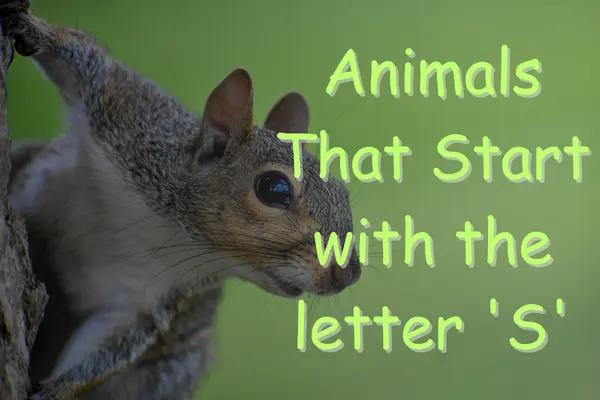
Animals Starting With S: Complete List
| Animal | Scientific Name | Group | Where It Lives | Notable For |
|---|---|---|---|---|
| Saanen Goat | Capra hircus | Mammal | Swiss origin, worldwide | Highest-yielding dairy goat breed |
| Saarloos Wolfdog | Canis lupus familiaris | Mammal | Netherlands | German shepherd × wolf cross, 1930s |
| Saber-Toothed Tiger | Smilodon spp. | Extinct mammal | The Americas | Not a tiger — a separate cat lineage |
| Sable | Martes zibellina | Mammal | Siberian forest | Marten with exceptionally soft fur |
| Sable Ferret | Mustela putorius furo | Mammal | Domesticated | Most common ferret colouring |
| Sable German Shepherd | Canis lupus familiaris | Mammal | Domesticated | Agouti coat; closest to the original breed colour |
| Sable Black German Shepherd | Canis lupus familiaris | Mammal | Domesticated | Sable with heavy black overlay |
| Saddleback Caterpillar | Acharia stimulea | Insect | Eastern North America | Venomous spines — painful sting |
| Salamander | Caudata order | Amphibian | Damp temperate regions | Regenerates limbs, heart and brain tissue |
| Salmon | Salmo / Oncorhynchus | Fish | N. Atlantic & Pacific | Returns to its natal river to spawn |
| Sand Cat | Felis margarita | Mammal | Sahara, Arabia, C. Asia | Survives without ever drinking water |
| Scorpion | Scorpiones order | Arachnid | Deserts and tropics | Glows blue-green under UV light |
| Sea Cucumber | Holothuroidea | Echinoderm | All oceans | Ejects its own organs to deter predators |
| Sea Lion | Otariidae | Mammal | Pacific coasts | Ear flaps; walks on all fours |
| Sea Otter | Enhydra lutris | Mammal | North Pacific coast | Densest fur of any animal; uses tools |
| Sea Turtle | Cheloniidae | Reptile | Tropical oceans | Nest temperature sets hatchling sex |
| Sea Urchin | Echinoidea | Echinoderm | Seafloor worldwide | Jaw called Aristotle’s lantern |
| Seahorse | Hippocampus spp. | Fish | Shallow tropical seas | Males carry the pregnancy |
| Seal | Phocidae | Mammal | Polar & temperate seas | No ear flaps; hauls on its belly |
| Serval | Leptailurus serval | Mammal | African savanna | Longest legs of any cat, proportionally |
| Shark | Selachimorpha | Fish | All oceans | Cartilage skeleton; older than trees |
| Sheep | Ovis aries | Mammal | Domesticated worldwide | Rectangular pupils, ~300° vision |
| Shrew | Soricidae | Mammal | Most continents | Must eat almost constantly; some venomous |
| Shrimp | Caridea | Crustacean | Fresh and salt water | Mantis shrimp strike boils the water |
| Skunk | Mephitidae | Mammal | The Americas | Sprays sulphur thiols up to 3 m |
| Sloth | Folivora | Mammal | Central & S. America | Algae grows in its fur for camouflage |
| Snail | Gastropoda | Mollusc | Nearly everywhere | Glides safely over sharp edges on mucus |
| Snake | Serpentes | Reptile | All but a few islands | Smells with its tongue; jaws not “unhinged” |
| Snow Leopard | Panthera uncia | Mammal | Central Asian mountains | Cannot roar; tail aids cliff balance |
| Sparrow | Passeridae | Bird | Worldwide | Among the most widespread wild birds |
| Spider | Araneae | Arachnid | Every continent but Antarctica | Silk stronger than steel by weight |
| Squid | Teuthida | Cephalopod | All oceans | Three hearts; blue copper-based blood |
| Squirrel | Sciuridae | Mammal | Worldwide except Antarctica | Forgotten caches become trees |
| Starfish | Asteroidea | Echinoderm | All oceans | No brain or blood; regrows arms |
| Stingray | Myliobatoidei | Fish | Coastal shallows | Venomous tail spine — dangerous |
| Stoat | Mustela erminea | Mammal | Northern hemisphere | Turns white in winter as ermine |
| Stork | Ciconiidae | Bird | Warm regions worldwide | Most species have no voice box |
| Swan | Cygnus spp. | Bird | Temperate wetlands | ~25 neck vertebrae; pairs often bond for life |
| Swordfish | Xiphias gladius | Fish | Temperate & tropical seas | Heats its own eyes and brain to hunt |
Mammals
Sloth
Sloths move so slowly that algae grows in grooves along their hair, tinting them green and providing camouflage — that fur supports a whole miniature ecosystem, including moths found nowhere else. Their metabolism runs at roughly half the rate expected for their size, and a single meal of leaves can take weeks to digest. They descend to the forest floor to defecate only about once a week, which is easily the most dangerous thing they routinely do.
Sea Otter
Sea otters have the densest fur of any animal — up to a million hairs per square inch — because unlike other marine mammals they carry almost no blubber and rely entirely on trapped air for insulation. They are among the few tool-using mammals, keeping a favoured rock to crack shellfish, and they wrap themselves in kelp while sleeping so they do not drift. As a keystone species they hold sea urchin numbers down; where otters disappear, kelp forests collapse into bare rock.
Snow Leopard
Snow leopards live as high as 5,500 metres across Central Asian mountains. They cannot roar — the necessary throat structure is absent — and instead chuff and mew. The tail is nearly as long as the body, used for balance on cliffs and wrapped over the face when resting in cold. Enlarged nasal cavities warm thin freezing air before it reaches the lungs.
Sand Cat
The only cat living entirely in true desert. It takes all its water from prey and can survive indefinitely without drinking. Thick fur covers the pads of its feet, insulating them from scorching sand and leaving almost no visible tracks — part of why the species went so long barely documented.
Serval
The serval has the longest legs relative to body size of any cat, plus outsized ears that locate rodents by sound alone, including prey moving underground. It hunts by leaping vertically — sometimes three metres — to drop through grass onto its target. Its success rate is among the highest of any cat, roughly half of all attempts.
Skunk
A skunk’s spray is a mix of sulphur compounds called thiols, fired from glands beside the anus accurately enough to hit a target three metres away. Skunks warn first — stamping, hissing, raising the tail — because the spray takes over a week to replenish and they are close to defenceless meanwhile.
Squirrel
Tree squirrels cache far more nuts than they ever recover, and the forgotten ones germinate, making them among the most effective tree-planters in temperate forests. They also perform deceptive caching when they think they are being watched, digging and covering empty holes while keeping the real nut in their mouth.
Stoat
In the north of its range the stoat moults to pure white in winter, keeping only a black tail tip — the fur known as ermine and used historically on ceremonial robes. The black tip is thought to misdirect raptors, which strike at it instead of the body. Stoats routinely kill prey several times their own size.
Sheep
Sheep have horizontal rectangular pupils giving roughly 300 degrees of vision without moving their heads — they can see behind themselves while grazing — and the pupils stay level with the horizon as the head tilts. They recognise and remember individual sheep and human faces for years.
Shrew
Shrews burn energy so fast that many must eat every two or three hours or starve, consuming more than their own body weight daily. Several echolocate, and some are among the very few venomous mammals, using toxic saliva to subdue prey. Despite appearances they are not rodents.
Marine and Freshwater Animals
Shark
Sharks predate trees — the lineage is over 400 million years old. Their skeletons are cartilage rather than bone, and their skin carries tooth-like denticles that cut drag. They sense the faint electrical fields of hidden prey through the ampullae of Lorenzini, pores clustered around the snout, and most species replace teeth continuously for life.
Seahorse
Seahorses are the only animals in which the male becomes pregnant in the full sense: the female deposits eggs in his brood pouch, where he fertilises them, supplies oxygen and nutrients, regulates the fluid and gives birth. They swim poorly, propelled by a rapidly beating dorsal fin, and anchor to seagrass with a prehensile tail.
Squid
Squid have three hearts — two serving the gills, one the body — and blue blood, because they carry oxygen with copper-based haemocyanin rather than iron. Chromatophores in the skin change colour in milliseconds for camouflage and signalling. The giant squid has the largest eye of any known animal, roughly the size of a dinner plate.
Seal
True seals differ from sea lions in two visible ways: no external ear flaps, and hind flippers that cannot rotate forward, so on land they haul along on their bellies. They are the better divers — elephant seals pass 1,500 metres and stay under well over an hour by collapsing their lungs and storing oxygen in blood and muscle.
Salmon
Salmon hatch in fresh water, migrate to sea and return years later to the exact river of their birth, navigating by magnetic field at sea and by smell in the final stretch. Their bodies remodel dramatically for the journey, and most Pacific species die shortly after spawning, carrying marine nutrients deep into inland forests.
Swordfish
Swordfish have a specialised muscle beside the eyes that warms the eyes and brain up to 15 °C above the surrounding water. Warm eyes process images far faster, letting them hunt in cold, deep water where prey would otherwise be near-invisible. The bill slashes through fish schools rather than spearing.
Starfish
Sea stars have no brain and no blood, circulating filtered seawater through a water vascular system that also drives hundreds of tube feet. Many push their stomach out through the mouth to digest prey externally, which lets them eat shellfish too large to swallow. Most regrow lost arms; a few regenerate a whole body from one.
Sea Turtle
Hatchling sex is set by nest temperature rather than chromosomes — warmer sand produces females — which makes sea turtles acutely vulnerable to a warming climate. Females return decades later to the beach where they hatched. Unlike freshwater turtles they cannot retract into their shells.
Stingray
Rays are flattened relatives of sharks that swim by rippling their pectoral fins, lie buried in sand and detect prey electrically. The tail spine is purely defensive.
Caution: a stingray’s barbed tail spine carries venom and inflicts deep, extremely painful puncture wounds that often become infected. Injuries almost always happen when someone treads on a buried ray. In shallow water where rays occur, shuffle your feet rather than stepping down — the vibration moves them off. Puncture wounds need medical attention.
Sea Urchin
Sea urchins graze algae with a five-toothed jaw apparatus called Aristotle’s lantern, after the philosopher’s description. Where predators such as sea otters are removed, urchin numbers explode and strip kelp forests to bare rock — urchin barrens that can persist for decades.
Sea Cucumber
Threatened sea cucumbers can eject their internal organs through the anus, leaving a predator with a meal while the animal escapes and regrows them over weeks. Some also expel sticky defensive threads. They recycle seafloor sediment much as earthworms process soil.
Sea Lion
Sea lions have visible ear flaps and can rotate their hind flippers forward to walk on all fours — which is why performing pinnipeds are almost always sea lions rather than seals. They are highly social and gather in noisy colonies.
Shrimp
The mantis shrimp — not a true shrimp, but the most remarkable animal carrying the name — strikes with a club-like limb at over 20 metres per second, fast enough to briefly boil the water in a cavitation bubble. Its eyes carry up to sixteen photoreceptor types against a human three.
Reptiles, Amphibians and Birds
Snake
Snakes smell by flicking the tongue to collect airborne particles and pressing it to the vomeronasal organ in the roof of the mouth — the forked tip gives direction, letting them follow a trail. Their jaws are not “unhinged” as commonly claimed: the two halves of the lower jaw are joined by an elastic ligament and move independently, which is what allows swallowing prey wider than the head. Pit vipers additionally detect infrared through facial pits, effectively seeing body heat.
Salamander
Salamanders regenerate entire limbs, tails, parts of the heart and even brain tissue — the most capable vertebrate regenerators known and a major focus of regenerative-medicine research. Many breathe partly or wholly through their skin, which must stay moist, confining them to damp habitats.
Swan
Swans typically form long-term pair bonds and both parents defend the cygnets fiercely. A swan’s neck holds around 25 vertebrae — more than three times a giraffe’s seven — giving it the reach to feed on the bottom of deep water.
Stork
Most storks have no functioning voice box and communicate by loudly clattering their bills. They are superb soarers, riding thermals hundreds of kilometres on migration with barely a wingbeat. The baby-delivering association comes from European folklore, helped by white storks nesting on chimneys and returning each spring.
Sparrow
The house sparrow is among the most widely distributed wild birds on earth, having followed human settlement onto nearly every continent. It has also declined sharply in some cities while thriving in others, for reasons still debated — a reminder that common does not mean secure.
Invertebrates
Spider
Spider silk is, weight for weight, stronger than steel and tougher than Kevlar, and a single spider may produce up to seven distinct silks for different jobs — frame, sticky capture spiral, egg sac, dragline. Spiders cannot chew; they inject digestive fluid and drink the result. Most have eight eyes but poor vision, navigating by vibration.
Scorpion
Scorpions fluoresce blue-green under ultraviolet light because of compounds in the cuticle; the function is still unclear. They are extraordinarily resilient, able to slow their metabolism enough to survive a year without food. Of roughly 2,000 species, around 25 have venom dangerous to humans.
Snail
Snails glide on a self-made mucus trail that lets them cross sharp surfaces unharmed — including, famously, a razor blade. Most land snails are hermaphrodites. Their radula, a ribbon of thousands of microscopic teeth, rasps food away.
Saddleback Caterpillar
Unmistakable: bright green with a brown oval “saddle” ringed in white on a stout brown body. It is the larva of a North American moth and is covered in venomous urticating spines.
Caution: the saddleback caterpillar’s spines deliver a sting often described as worse than a wasp’s, with burning pain, swelling, rash and occasionally nausea. Reactions can persist for days. Never handle one; if spines lodge in skin, lift them out with adhesive tape rather than rubbing, which drives them deeper.
Domestic Breeds and Extinct Species
Saanen Goat
A Swiss dairy breed and the highest-yielding goat in the world, producing large volumes of mild, low-fat milk. Saanens are always white or cream, and their pale skin burns easily, so they need shade in hot climates.
Saarloos Wolfdog
Created in the Netherlands in the 1930s by Leendert Saarloos, who crossed a German shepherd with a European grey wolf hoping for a hardier working dog. The result kept too much wolf caution and reserve to be a reliable service animal, and it is now a companion breed for experienced owners.
Sable German Shepherd
Sable is an agouti pattern in which each hair is banded with several colours, giving a shifting grey-brown coat. It is genetically dominant and is the closest surviving colour to the original dogs bred by Max von Stephanitz.
Sable Black German Shepherd
A darker expression of the same sable pattern, with heavy black tipping over the banded hairs. Puppies often change shade considerably as they mature, so adult colour is hard to predict early.
Sable
The wild sable is a marten of Siberian forest, hunted for centuries for a pelt considered among the softest of any animal — soft in every direction, unlike most furs. Russian sable functioned as a currency in its own right and drove much of the eastward expansion across Siberia.
Sable Ferret
The commonest domestic ferret colouring: warm brown guard hairs over a cream undercoat with a distinct mask. Ferrets have been domesticated for at least two thousand years, originally to hunt rabbits out of burrows.
Saber-Toothed Tiger
Not a tiger and not closely related to one. Smilodon belonged to a separate extinct cat lineage and was far more heavily built than any living cat, with forelimbs adapted to wrestle large prey down. Its canines reached 28 cm but were surprisingly fragile, suited to a precise bite on an already-restrained animal rather than a chase. It died out roughly 10,000 years ago.
Frequently Asked Questions
What animals start with the letter S?
Thirty-nine are covered here, including shark, snake, seal, sloth, squirrel, swan, spider, scorpion, seahorse, squid, starfish, stingray, sea otter, sea turtle, sea lion, snow leopard, skunk, sheep, salmon, salamander, sparrow, stork, snail, shrimp, shrew, stoat, serval, sand cat, swordfish, sea urchin and sea cucumber, plus domestic breeds and the extinct saber-toothed cat.
Which S animal is the slowest?
The sloth, by a wide margin — roughly 4 metres per minute, with a metabolism running at about half the rate expected for its size.
Is a seahorse really a fish?
Yes. Seahorses are bony fish with gills, a swim bladder and fins, despite the upright posture and horse-like head. They are the only animals in which the male carries the pregnancy.
What is the difference between a seal and a sea lion?
Two visible things. Sea lions have external ear flaps and rotate their hind flippers forward to walk on land. True seals have no ear flaps and shuffle on their bellies. Seals dive deeper; sea lions are the ones you see performing.
Which S animal has three hearts?
The squid. Two hearts serve the gills and a third the body, and its blood is blue because it carries oxygen with copper-based haemocyanin instead of iron.
What is the most dangerous animal starting with S?
By actual risk of injury, the stingray and the saddleback caterpillar — both cause painful envenomation and both are commonly encountered. Sharks attract far more fear than their incident rate justifies; most species are harmless to people.
Sources
Classifications and distributions follow current taxonomic references. Stingray and saddleback caterpillar envenomation: clinical toxicology literature. Sea otter keystone role and urchin barrens: marine ecology research. Sea turtle temperature-dependent sex determination: herpetological literature.
This article is for general information. Do not handle wild animals, and treat any venomous sting or puncture wound as needing medical assessment.

Justwebworld has published guides since 2012. How we write and update articles Report an error
