

Note (September 2026): Earlier versions of this page presented daily limits of 30 minutes for 18-24 months, 1.5 hours for ages 6-10 and under 2 hours for teens as pediatric (AAP) guidance; the AAP sets no such figures. The age guide has been corrected against current AAP, WHO and Indian Academy of Pediatrics guidance, including the AAP’s January 2026 policy statement.
Screen time by age, according to the American Academy of Pediatrics (AAP): avoid screens before 18 months except video chatting; from 18 to 24 months, use only high-quality media watched with an adult; from 2 to 5 years, keep it to about 1 hour a day of high-quality programming. The AAP sets no fixed hour limit for older children and teens; its 2026 guidance focuses on content, sleep and a family media plan.
Key Takeaways
- Under 18 months: the AAP advises no screens except video chatting with family; the WHO (2019) advises no screen time under age 1 and no sedentary screen time at age 1.
- Ages 2-5: the AAP, the WHO and the Indian Academy of Pediatrics (IAP) all put the ceiling at about 1 hour a day, and the WHO adds that less is better.
- School-age children and teens: the AAP sets no hour limit. The IAP advises under 2 hours a day for ages 5-10, and Canada’s 24-Hour Movement Guidelines advise no more than 2 hours of recreational screen time for ages 5-17.
- The AAP’s January 2026 policy statement moves beyond simple time limits toward quality, context and conversation, using the “5 Cs” and a Family Media Plan.
- What screens crowd out matters most: sleep, physical activity, play and family time are the benchmarks every guideline protects.
Introduction: Understanding Screen Time by Age
Today, screens are everywhere—TVs, tablets, smartphones, computers, smartwatches, and even educational toys. As a parent, it’s natural to wonder: “How much screen time is too much for my child?” The answer depends on your child’s age, their developmental stage, and what kind of content they’re consuming.
Pediatrician Recommended Screen Time – Smart Screen Time Tips for Parents
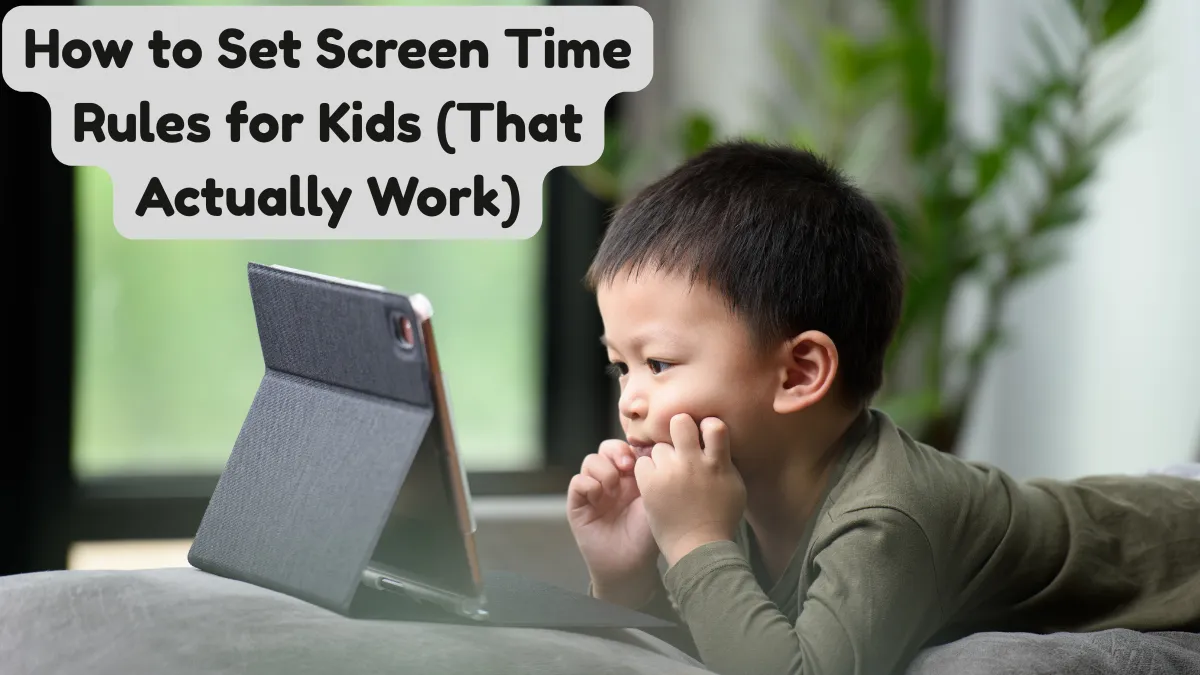
According to child-health bodies such as the American Academy of Pediatrics (AAP), what children watch and how screens fit into the day matter as much as the number of minutes. But unchecked screen time can interfere with sleep, physical activity, and brain development. This guide will help you understand the screen time limits by age, including pediatrician recommended screen time, and provide simple, effective strategies to build healthy digital habits for kids.
Let’s explore the latest screen time recommendations, learn how to balance screen exposure, and become confident in managing your child’s digital world.
What Is Screen Time? Why It Matters More Than Ever
Screen time refers to the amount of time a person spends using devices with screens—including TVs, computers, tablets, smartphones, and video game consoles.
With online homework, video calls and streaming entertainment now part of daily life, screens are built into most children’s routines at school and at home. That’s why understanding digital screen time recommendations is critical.
Too much screen time can:
-
Reduce sleep quality
-
Affect attention span
-
Lower physical activity levels
-
Disrupt emotional and social development
But when used wisely, screens can also support learning and communication.
Pediatrician Recommended Screen Time by Age
The American Academy of Pediatrics screen time guidelines are among the most widely cited in the world, alongside the World Health Organization (WHO) guidelines for children under 5. Here’s a simplified screen time chart by age based on AAP guidance, with WHO and Indian Academy of Pediatrics (IAP) advice noted where it differs:
🍼 Babies (0-18 months):
-
Recommendation: Avoid all screen time except video chatting with family.
-
Why: Brain development at this stage relies on real-life interaction.
👶 Toddlers (18-24 months):
-
Recommendation: If introduced, screen time should be limited to high-quality content and co-viewed with parents.
-
Max Time: no minute limit is set by the AAP; keep any use short, high-quality and shared with an adult (the WHO advises no sedentary screen time before age 2, and the IAP advises no screen exposure before age 2).
👦🏻 Kids Age 2-5:
-
Recommended Screen Time for Toddlers: Up to 1 hour/day of high-quality programming (AAP); the WHO says no more than 1 hour, and less is better
-
Important: Parents should co-watch and talk about the content.
👧 Kids Age 6-10:
-
Screen Time Limits for Children: The AAP sets no fixed number of hours for this age. Its current guidance asks families to use a Family Media Plan and make sure screens do not crowd out sleep, physical activity, schoolwork and family time. The IAP advises less than 2 hours a day for ages 5-10.
-
Tip: Prioritize active and educational content.
👨🏫 Tweens & Teens (11-18):
-
Healthy Screen Time for Kids: The AAP sets no hour limit for teens. Canada’s 24-Hour Movement Guidelines advise no more than 2 hours a day of recreational screen time up to age 17, and the IAP asks adolescents to balance screens with at least 1 hour of outdoor activity and 8-9 hours of night-time sleep.
-
Important: Monitor social media, gaming, and online safety.
Why Screen Time Recommendations Exist (The Science Behind It)
Research consistently shows that excessive screen exposure can affect:
-
Cognitive development
-
Language skills
-
Mental health
-
Physical health (like obesity and eye strain)
These screen time guidelines for kids are backed by neuroscience, pediatrics, and behavioral psychology. Screen time recommendations by pediatricians are designed to maximize benefits while reducing risks.
Screen Time Chart by Age (Quick Reference)
| Age Group | Recommended Daily Screen Time |
|---|---|
| 0-18 months | None (except video chatting) |
| 18-24 months | No AAP minute limit; if used, high-quality and co-viewed (WHO and IAP: none before age 2) |
| 2-5 years | Up to 1 hour (high-quality and co-viewed); WHO: less is better |
| 6-10 years | No AAP hour limit; IAP: under 2 hours a day (ages 5-10) |
| 11-18 years | No AAP hour limit; Canada: 2 hours or less of recreational screen time |
Note: These are general guidelines. Adjust based on child needs, content type, and family lifestyle.
How Much Screen Time Is Too Much?
If your child shows any of the following, it might be a sign of too much screen time:
-
Constant tantrums when devices are taken away
-
Trouble sleeping or falling asleep late
-
Declining interest in physical play
-
Lack of social interaction
-
Eye fatigue or headaches
The key is to watch for behavioral changes and act early. Use these signs as a cue to re-evaluate screen time rules.
How to Set Healthy Digital Habits for Kids
Setting boundaries doesn’t have to be a battle. Here are practical, widely recommended screen time tips for parents:
-
Create a Family Media Plan
-
Set clear screen time rules for kids.
-
Include device-free times and zones (like dinner time or bedrooms).
-
-
Use Timers or Screen Limit Apps
-
Apps like Google Family Link or Apple Screen Time help automate limits.
-
-
Prioritize Active Screen Use
-
Encourage kids to create (draw, code, make videos) instead of just consuming.
-
-
Model Good Behavior
-
Kids mimic you. Limit your own screen use around them.
-
-
Encourage Offline Alternatives
-
Reading, crafts, outdoor play, music, and board games can reduce dependency.
-
Educational Screen Time vs. Entertainment Screen Time
Not all screen time is created equal. There’s a big difference between watching cartoons and engaging with a learning app.
Educational Screen Time:
-
Learning apps (like Khan Academy Kids, ABCmouse)
-
Science or history YouTube channels
-
Audiobooks and story apps
Entertainment Screen Time:
-
Passive video watching
-
Video games (non-educational)
-
Social media scrolling
Tip: If screen time promotes thinking, interacting, or creativity—it’s more valuable.
Best Screen Time Management Tools for Parents
Here are trusted tools to help you manage and monitor screen usage:
-
Google Family Link (Android)
-
Apple Screen Time (iOS)
-
Qustodio (Cross-platform monitoring)
-
Bark (For social media and text monitoring)
-
Canopy (Smart content filtering)
These tools help enforce screen time rules for kids and offer reports that show how your child uses their devices.
Reducing Screen Time for Children Without Power Struggles
Looking to limit screen time for toddlers or reduce it for older kids without daily battles? Try these steps:
-
Give Choices: Offer 2-3 non-screen options (e.g., puzzles, Lego, storytime).
-
Use Visual Schedules: Toddlers especially respond well to routines and pictures.
-
Replace, Don’t Just Remove: Replace screen time with something just as exciting.
-
Praise Offline Time: Positive reinforcement works wonders.
Conclusion: Parenting in a Screen-Filled World
You don’t need to eliminate screens entirely. Instead, aim for balance, awareness, and intention.
By following these screen time guidelines, you’re not just setting limits—you’re empowering your child to develop a healthy relationship with technology. The key is quality over quantity, paired with conversation, connection, and co-viewing.
Stay flexible, stay informed, and always put connection before control.
How Has the AAP’s Screen Time Guidance Changed?
The American Academy of Pediatrics released a new policy statement, Digital Ecosystems, Children, and Adolescents, on January 20, 2026, together with a technical report published in the February 2026 issue of the journal Pediatrics. The statement replaces earlier AAP media guidance and looks at children’s digital lives as a whole system: caregiver relationships, platform design, commercial incentives and wider social factors.
The biggest change is emphasis. According to the AAP’s parent website, HealthyChildren.org, the updated guidance aims to “move beyond simple screen-time limits and focus on quality, context and conversation.” The AAP now points parents to the 5 Cs of Media Use and a Family Media Plan instead of a single daily number for every child.
The statement also puts responsibility on technology companies. It warns that many platforms are built around a business model that keeps users engaged for as long as possible, and it includes recommendations for industry and policy makers as well as for families and pediatricians.
Do the Age Limits for Young Children Still Apply?
For the youngest children, the core advice has not changed. The AAP’s parent guidance still says infants under 18 months learn best from real-world interaction, and CHOC, a pediatric health system in California, summarizes the 2026 update as keeping no screens before 18 months and about 1 hour of high-quality content a day for ages 2 to 5. For school-age children and teens, the AAP no longer leads with an hour limit.
What Does the AAP Tell Parents to Do Now?
- Create device-free zones and times, such as bedrooms, mealtimes and the hour before bed.
- Delay giving young children their own tablet.
- Watch and play together with younger children.
- Model healthy habits with your own devices.
- Use parental controls alongside a Family Media Plan, not instead of one.
AAP vs. WHO vs. IAP: Screen Time Guidelines Compared
Three major bodies publish screen time guidance for young children: the American Academy of Pediatrics (United States), the World Health Organization (global, 2019 guidelines for children under 5) and the Indian Academy of Pediatrics (India, 2021 guidelines published in Indian Pediatrics). The table compares their advice by age.
| Age | AAP | WHO (2019) | IAP (2021) |
|---|---|---|---|
| Under 12 months | Avoid screens except video chatting | Screen time not recommended | No screen exposure |
| 12-18 months | Avoid screens except video chatting | Sedentary screen time not recommended | No screen exposure |
| 18-24 months | If introduced, high-quality and co-viewed; no minute limit set | Sedentary screen time not recommended (age 1) | No screen exposure |
| 2-5 years | Up to 1 hour a day of high-quality programming, co-viewed | No more than 1 hour; less is better (ages 2-4) | Maximum 1 hour a day, supervised (24-59 months) |
| 5-10 years | No fixed limit; 5 Cs and Family Media Plan | Not covered by the under-5 guidelines | Less than 2 hours a day |
| 10-18 years | No fixed limit; 5 Cs and Family Media Plan | Not covered by the under-5 guidelines | Balance screens with outdoor activity, sleep, study and family time |
The main difference is at 18 to 24 months. The AAP allows limited, high-quality media shared with an adult from 18 months, while the WHO and the IAP advise no screen time until age 2. Parents who want the most cautious standard can follow the WHO and IAP advice for this age.
For older children, Canada’s 24-Hour Movement Guidelines are one of the few official sources that still give a number: no more than 2 hours a day of recreational screen time for ages 5 to 17.
What Are the 5 Cs of Media Use?
The 5 Cs of Media Use are the AAP’s framework for deciding how much and what kind of screen time suits a particular child. The AAP publishes age-based versions for infants, toddlers and preschoolers, school-age children, young teens and older teens.
- Child: every child is different, so consider your child’s age, personality and how media affects them.
- Content: look at what your child watches, plays and scrolls, not only for how long.
- Calm: notice whether screens have become the main way your child calms down or falls asleep, and help build other ways to manage strong emotions.
- Crowding out: ask what screen time is replacing, such as sleep, outdoor play, reading or family time.
- Communication: talk with your child about what they see online and share screen time where you can.
For babies and toddlers, the “crowding out” question matters most, because early learning depends on talking, play and hands-on exploration. This guide to activities that support toddler brain development at home offers screen-free ideas.
How to Make a Family Media Plan
A Family Media Plan is a written set of household screen rules that parents build with their children. The AAP offers a free Family Media Plan tool on HealthyChildren.org that families can fill in online and adjust for each child.
- Set screen-free zones: for example, bedrooms, the dining table and the car.
- Set screen-free times: meals, family time and at least the hour before bed.
- Agree on content: which apps, games, channels and social platforms are allowed at each age.
- Protect the essentials first: schedule sleep, physical activity, homework and play, then fit screens around them.
- Choose the tools: parental controls, time limits and content filters that support the plan.
- Review it regularly: revisit the plan as children grow or when new devices arrive.
Parental control apps can enforce the rules you agree on; this overview of parenting apps for kids’ safety covers common options. If a first phone is on the horizon, see what age to buy a child a first smartphone. None of the guidelines cited in this article sets a specific age for a first phone.
What Should Screen Time Not Replace? Sleep and Activity Benchmarks
Every major guideline treats sleep and physical activity as the things screen time must not crowd out. These official benchmarks help parents judge whether screen use is squeezing the day.
| Age | Physical activity | Sleep | Source |
|---|---|---|---|
| 1-2 years | At least 180 minutes a day of varied activity | 11-14 hours, including naps | WHO (2019) |
| 3-4 years | At least 180 minutes a day, including 60 minutes moderate-to-vigorous | 10-13 hours, including naps | WHO (2019) |
| 5-13 years | At least 60 minutes a day moderate-to-vigorous | 9-11 hours | Canadian 24-Hour Movement Guidelines |
| 14-17 years | At least 60 minutes a day moderate-to-vigorous | 8-10 hours | Canadian 24-Hour Movement Guidelines |
How Long Before Bed Should Screens Go Off?
Screens should go off at least 1 hour before bedtime. The AAP lists the hour before bed among device-free times, and the IAP guidelines recommend switching screens off 1 hour before bedtime because light from devices can suppress melatonin, the hormone that helps the body sleep.
How Can Children Reduce Eye Strain From Screens?
The IAP guidelines recommend the 20-20-20 rule: after 20 minutes of screen use, take a 20-second break and look at something about 20 feet away. The IAP also advises good posture at computers and phones. Screen-free hobbies help too; this board games guide can help families find games for different ages.
When Should Parents Talk to a Pediatrician About Screen Use?
Parents should talk to a pediatrician when screen use starts to affect sleep, mood, school, friendships or physical activity, or when a child cannot stop despite clear limits. The IAP guidelines ask families, schools and pediatricians to watch for signs of media addiction and cyberbullying and to seek expert help early.
- Regular late nights or poor sleep linked to devices
- Intense anger or distress when screens are removed
- Losing interest in friends, sport or hobbies
- Falling grades or skipped homework
- Secrecy about online activity, or signs of being bullied online
These signs can also overlap with anxiety, low mood and other concerns, so a professional assessment is more useful than a new rule alone. For broader support, see these tips to improve your children’s mental health. This article is general information and does not replace advice from your child’s own doctor.
FAQs About Screen Time by Age
1. What is the recommended screen time for toddlers?
For ages 2 to 5, the AAP advises up to 1 hour a day of high-quality programming, ideally watched with a parent. For toddlers under 2, the AAP advises only limited, high-quality, co-viewed media after 18 months, while the WHO and the IAP advise no screen time before age 2.
2. Can screen time help my child learn?
Yes, if it’s educational, interactive, and age-appropriate.
3. What are signs my child has too much screen time?
Sleep issues, tantrums, social withdrawal, or lack of interest in offline play.
4. Is screen time bad for babies?
Yes, except for supervised video calls with family. Avoid other screen use.
5. How do I reduce screen time for children gently?
Set routines, offer fun alternatives, and use visual charts.
6. Does background TV count as screen time?
Yes, it is worth counting. Nemours KidsHealth, which bases its advice on AAP recommendations, tells parents not to leave screens on in the background, even when no one is actively watching.
7. What are healthy screen time limits for kids age 2-5?
Up to 1 hour a day of high-quality programming, according to the AAP, the WHO (which adds that less is better) and the IAP.
8. Where can I get a full screen time chart by age?
This article includes a quick-reference table above and a comparison of AAP, WHO and IAP guidance by age below.
Remember: It’s not about being perfect but being present. With the right guidance, your child can thrive in the digital world — one healthy screen habit at a time.
Has the AAP dropped screen time limits?
The AAP did not drop all limits, but it changed its emphasis. Its January 2026 policy statement moves beyond simple time limits toward quality, context and conversation, while, according to CHOC’s summary of the update, the advice for young children remains: no screens before 18 months and about 1 hour a day of high-quality content for ages 2 to 5.
What does the WHO recommend for screen time under age 5?
The WHO’s 2019 guidelines say screen time is not recommended for infants under 1, sedentary screen time is not recommended at age 1, and children aged 2 to 4 should have no more than 1 hour of sedentary screen time a day, with less being better.
Does video chatting count as screen time for babies?
The AAP makes an exception for video chatting. It advises avoiding screens before 18 months except video chatting with family, done together with an adult. The WHO’s under-5 guidelines do not make this exception explicitly and simply say screen time is not recommended under age 1.
Does educational content count toward the 1-hour limit for preschoolers?
Yes. The 1-hour ceilings from the AAP, the WHO and the IAP describe total screen time for ages 2 to 5, and the AAP’s hour is meant to be high-quality programming in the first place. Educational apps and shows are the recommended way to use that hour, not an addition to it.
How much screen time is healthy for a teenager?
No single number applies. The AAP sets no hour limit for teens and focuses on content, sleep and family rules, while Canada’s 24-Hour Movement Guidelines advise no more than 2 hours a day of recreational screen time up to age 17, alongside 60 minutes of activity and 8-10 hours of sleep for ages 14 to 17.

Justwebworld has published guides since 2012. How we write and update articles Report an error
