

A swing tag (called a hang tag in the US) is a removable card attached to a product with string or a plastic tie that carries the brand name, logo, price, size and product details. To design one, choose a size such as 2 x 3.5 inches, set artwork to CMYK at 300 dpi with a 0.125-inch bleed, and keep legally required fiber and care details on the sewn-in label.
Key Takeaways
- A swing tag and a hang tag are the same thing: “swing tag” is the usual UK term and “hang tag” the usual US term.
- Printers commonly offer 2 x 2, 2 x 3 and 2 x 3.5 inch tags; UPrinting lists custom sizes from 2 x 2 up to 8.5 x 11 inches (as of September 2026).
- Print-ready files are normally CMYK, 300 dpi, with a 0.125-inch bleed on every edge.
- A swing tag does not replace the permanent care label or the fiber-content label that US and EU rules require on clothing.
- A GS1 US single GTIN for a barcode costs a one-time $30 with no renewal fee (as of September 2026).
In retail, you will find that a lot of products will include swing tags. There are many reasons for this. Namely, it is a way for you to communicate with your customers and make a statement. Of course, you are telling them the price of an item.
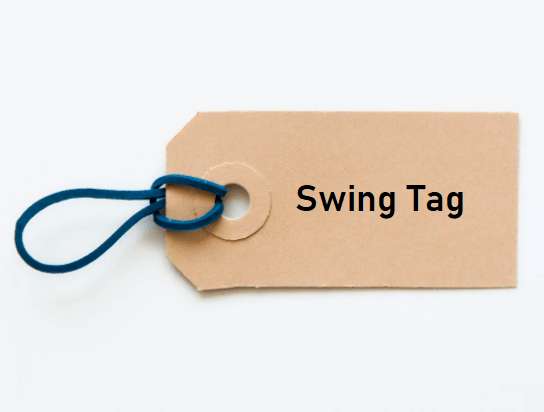
But, you are also getting the opportunity to share your brand. But, if you have never designed a swing tag, it is important that you take some time to learn about them first. It may not be as easy as you think. So, here are some tips on designing a swing tag for your brand.
What is a Swing Tag?
First of all, do you know what a swing tag is? Simply, this is an element that is often added to products. It can also be referred to as a label or hang tags depending on what country you are in. Swing tags differ mainly in the material they are printed on: card stock is the most common choice, and printers sell coated, laminated and uncoated card in several thicknesses. The tag is printed onto paper or card, punched with a hole, and attached to the product with yarn, twine, string or a plastic tie.
If you are thinking of creating a swing tag for your products, know that one of the most important things is to have them professionally printed. This is going to make sure that your design stands out and looks good.
Make the Design Unique
Remember that swing tags are going to be reflecting your brand. This means that you want to put in a lot of effort when it comes to design.
You are going to have competition out there and your swing tag is an opportunity to stand out from the crowd. You can choose everything from the shape to the colour and this is going to tell a story about your brand. Take some time to think over what you want your design to show.
For example, a good way to make your swing tags stand out is to consider a print finishing service. In other words, a finishing service can add the wow factor to your swing tags. You can make them a matt, gloss or even a velvet finish to add the final touches to your design.
This can allow customers to touch and explore your tags, making it stand out from the competition. Just make sure that the design is something that runs parallel to your brand message.
Know all the Important Information
If you have never designed a swing tag before, you might not be sure what to include on them. Indeed, there is a lot of important information you want to include since this is a point of sale tool.
First of all, you are going to want to have your brand name and logo on the swing tag. After all, this is a marketing tool that people need to know where they are buying from.
It is also useful to include a short tagline that sums up your brand’s values or business ethics. You can also choose to include a story if you feel that it is going to reflect well for your business.
In addition, social media handles are beneficial so there is a type of contact for the customer. Of course, you want to include important details on the product the person is buying too. This includes the price and size, and you can repeat the care instructions and fabric composition. A swing tag does not replace the legally required label, though: in the US, the Federal Trade Commission requires care instructions on a label attached permanently to most garments, and in the EU the fibre composition must appear on a label firmly attached to the product, for example sewn in.
Research Your Customers
When you are designing a swing tag, you want to create something that you love. After all, it is going to be attached to all of your products and represent your brand.
But, you have to remember that the most important thing is making sure that your customers love the swing tags and they are able to gain good information from them. You also want to make people intrigued and want to learn more about you.
In order to have success with the swing tags, do some research on your customers. Find out about elements that they like and try to include them on your swing tags. For example, if you have a lot of younger people purchasing your products, it can be beneficial to have social media hashtags and profiles on the swing tags.
They are more likely to post about you on X (formerly Twitter) or share an image on Instagram. If you have customers that like a bargain, perhaps you can include a first-time customer discount on the swing tag. Again, with some research, you are going to be able to find elements that your customers like and you can include them on the design.
What Should a Swing Tag Include?
A swing tag should include the information a shopper needs at the moment of purchase plus the details that identify your brand. Printers and label makers list the same core elements: brand name, logo, barcode, price, size and care or product details.
| Element | Why it matters | Required by law on the tag? |
|---|---|---|
| Brand name and logo | Identifies who made or sells the product | No (US law requires the company name or RN on a label, not specifically on the swing tag) |
| Price | Lets shoppers and staff see the price without a separate sticker | Depends on local price-marking rules |
| Size and style or SKU code | Speeds up stock checks and returns | No |
| Barcode (UPC/EAN) | Lets retailers and marketplaces scan and list the product | No, but often a retailer requirement |
| Fiber content and care instructions | Helps the buyer; can be repeated from the sewn-in label | Must be on the attached label for most clothing in the US and EU; the tag can only repeat it |
| Tagline, brand story, social handles or QR code | Marketing and contact with the customer | No |
Swing Tag vs. Care Label: What Is the Difference?
A swing tag is removable marketing and pricing material, while a care label is a permanent label that stays on the garment. The difference matters because the law puts some information on the permanent label only.
- United States, care: The Federal Trade Commission’s Care Labeling Rule says care labels must be attached permanently and stay legible for the useful life of the product. A hang tag is allowed instead only in narrow cases, such as totally reversible clothing without pockets, and hosiery can carry care instructions on a hang tag or package.
- United States, fiber content: Under the FTC’s textile labeling guidance, labels must show fiber content, country of origin and the company name or Registered Identification Number (RN). A hang tag that names one fiber must make clear it does not give the full fiber content, for example “See label for the product’s full fiber content.”
- European Union: According to the EU’s Your Europe business portal, a textile label must list fibre composition in decreasing percentage order and be firmly attached to the product, for example sewn in; care instructions are not mandatory but must be clearly separated from the composition information.
- United Kingdom: Fibre content labelling is set by the Textile Products (Labelling and Fibre Composition) Regulations 2012, which still refer to EU Regulation 1007/2011.
For a designer, the practical rule is simple: put brand, price and marketing on the swing tag, and keep compliance information on the sewn-in label.
How to Design a Swing Tag Step by Step
- Decide the job of the tag. List what it must carry (price, size, barcode) and what it may carry (story, tagline, social handles).
- Choose a size and shape. Common standard sizes are 2 x 2, 2 x 3 and 2 x 3.5 inches. Die-cut shapes are possible and need bleed around every cut.
- Plan the hole. Leave clear space around the punch. UPrinting, for example, drills holes of 1/8, 3/16, 1/4 or 5/16 inch at the top, sides or corners, and does not include string.
- Set up the file. Work in CMYK at 300 dpi and add a 0.125-inch bleed on every edge, including around holes and cut-outs. The RGB to CMYK converter gives approximate print values for brand colors defined for screens.
- Check legibility. Small print on a small tag must be readable. The web accessibility standard WCAG 2.1 asks for a contrast ratio of at least 4.5:1 for normal text and 3:1 for large text; the same target is a sensible guide for print. You can test color pairs with the WCAG contrast checker.
- Pick stock and finish. Choose the card and coating (see the table below).
- Proof a sample. Order a printed proof, attach it to a real product and check the barcode scans before the full run.
Card Stocks and Finishes Compared
Card thickness for swing tags is often given in points (pt), where a higher number means thicker card. The options below are those listed by the US printer UPrinting for clothing hang tags as of September 2026; other printers offer their own ranges.
| Stock | Finishes offered | Good for |
|---|---|---|
| 14 pt coated card | Gloss, matte, high-gloss UV | Bright colors and photos |
| 16 pt coated card | Gloss, matte | A stiffer tag with the same print look |
| 16 pt laminated card | Fine grit, silk, soft touch | A tactile, premium feel when customers handle the tag |
| 14 pt and 17 pt uncoated card | None (natural paper surface) | A natural look, and writing on the tag by hand |
How to Get a Barcode for a Swing Tag
Most retailers scan a GS1 barcode, which encodes a Global Trade Item Number (GTIN). According to GS1 US, a single GTIN costs a one-time $30 with no annual renewal, which suits a small brand with a few products. Brands with larger ranges buy a GS1 Company Prefix instead: GS1 US lists $250 plus $50 a year for 10 items and $750 plus $150 a year for 100 items (as of September 2026). For background, see this guide to barcode solutions for small businesses.
Common Swing Tag Mistakes to Avoid
- No bleed: artwork that stops at the trim line can leave white slivers after cutting.
- RGB files: printers ask for CMYK, and screen colors can shift in print.
- Text too small or low contrast: the price and size should be easy to read.
- Relying on the tag for legal information: fiber content and care instructions still belong on the attached label for most clothing.
- Crowding the hole area: text too close to the punch can be cut or hidden by the string.
Tags are part of a product’s packaging footprint; read more about sustainable labelling for a circular packaging economy, and for adding a scannable link to your tag, see why businesses use QR codes.
Frequently Asked Questions
What is the difference between a swing tag and a hang tag?
There is no difference in the product. “Swing tag” is the common term in the UK and “hang tag” the common term in the US; both describe a removable card attached with string, twine or a plastic tie.
What size should a swing tag be?
Common standard sizes are 2 x 2, 2 x 3 and 2 x 3.5 inches. Printers such as UPrinting also offer custom sizes from 2 x 2 up to 8.5 x 11 inches, so choose a size that fits your product and the information you need to show.
What resolution and color mode should swing tag artwork use?
Swing tag artwork should be CMYK at 300 dpi with a 0.125-inch bleed on each side, including around holes and die-cut shapes. Always follow your printer’s own file guide if it differs.
Can care instructions go only on a swing tag?
Usually not. In the US, the FTC’s Care Labeling Rule requires care instructions on a permanently attached label for most garments, with narrow exceptions such as reversible clothing without pockets and hosiery. The swing tag can repeat the care instructions, but it cannot replace the label.
How much does a barcode for a product tag cost?
According to GS1 US, a single GTIN costs a one-time $30 with no renewal fee as of September 2026. A GS1 Company Prefix for 10 items costs $250 plus $50 a year.

Justwebworld has published guides since 2012. How we write and update articles Report an error
