

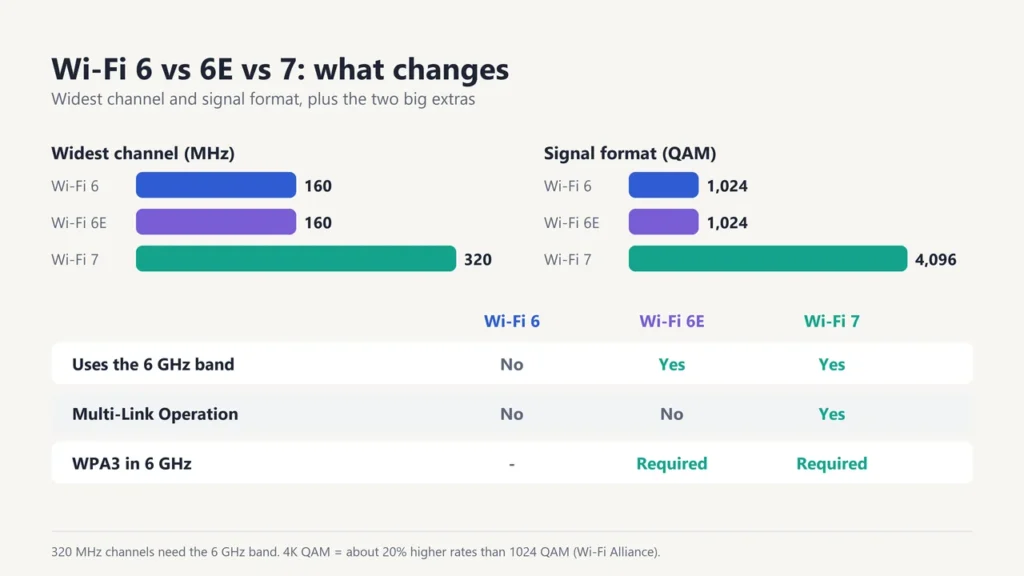
Wi-Fi 7 is the newer generation. Compared with Wi-Fi 6, it adds channels twice as wide (320 MHz, in the 6 GHz band), a denser signal format (4K QAM, about 20% faster than Wi-Fi 6’s 1024 QAM), and Multi-Link Operation, which lets a device use more than one band at the same time. Wi-Fi 6E sits in between. It is Wi-Fi 6 with access to the extra 6 GHz band.
For most homes, the real-world difference depends on three things: your internet plan, whether your phone or laptop also supports Wi-Fi 7, and whether your country allows Wi-Fi in the 6 GHz band. This guide explains each generation using information from the Wi-Fi Alliance (the group that certifies Wi-Fi products), the IEEE (which writes the technical standards), and national radio regulators.
- Wi-Fi 6: certified since September 2019. Uses 2.4 GHz and 5 GHz, with channels up to 160 MHz
- Wi-Fi 6E: certified since January 2021. Wi-Fi 6 features, extended into the 6 GHz band
- Wi-Fi 7: certified since January 2024. Uses 2.4, 5 and 6 GHz, with 320 MHz channels, Multi-Link Operation and 4K QAM
- WPA3 security is mandatory whenever Wi-Fi uses the 6 GHz band
- To get Wi-Fi 7 benefits, both the router and the device must support Wi-Fi 7
Wi-Fi 6 vs Wi-Fi 6E vs Wi-Fi 7 at a glance
| Feature | Wi-Fi 6 | Wi-Fi 6E | Wi-Fi 7 |
|---|---|---|---|
| IEEE standard | 802.11ax | 802.11ax in 6 GHz | 802.11be |
| Certification began | 16 Sept 2019 | 7 Jan 2021 | 8 Jan 2024 |
| Bands | 2.4 GHz, 5 GHz | 2.4 GHz, 5 GHz, 6 GHz | 2.4 GHz, 5 GHz, 6 GHz |
| Widest channel | 160 MHz | 160 MHz | 320 MHz (6 GHz only) |
| Signal format (QAM) | 1024 QAM | 1024 QAM | 4K QAM (4096) |
| Multi-Link Operation | No | No | Yes |
| Security | WPA3 required for certification | WPA3 required in 6 GHz | WPA3 required in 6 GHz |
You may notice there are no speed numbers in this table. The Wi-Fi Alliance does not publish a single top speed for Wi-Fi 6 or Wi-Fi 7. It describes Wi-Fi 7 as enabling “multigigabit” device speeds. The IEEE says its 802.11be standard was designed to support a maximum throughput of at least 30 Gbit/s. That is a lab design target for the whole standard, not a speed any home device will reach.
What is Wi-Fi 6?
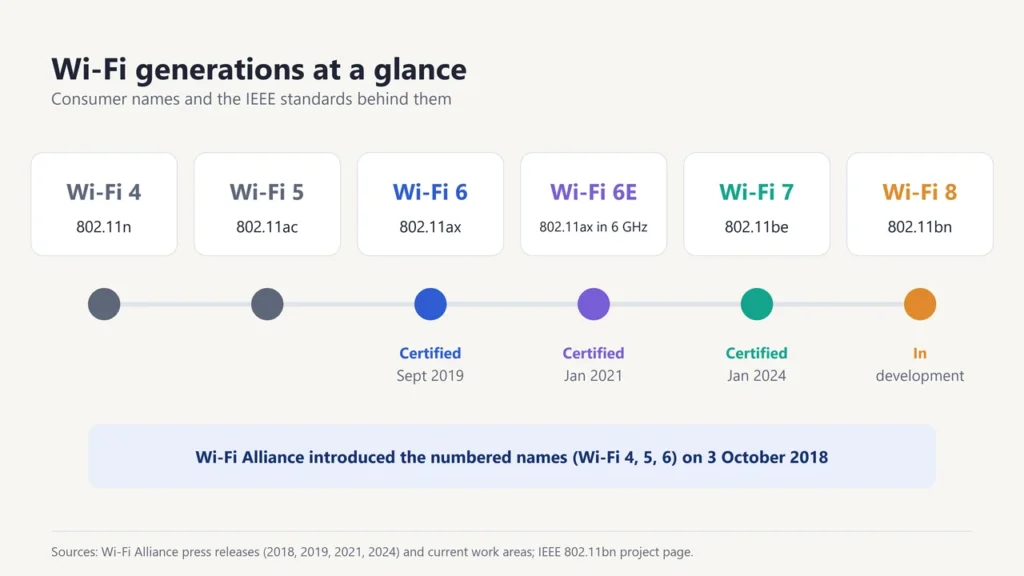
Wi-Fi 6 is the consumer name for the IEEE 802.11ax standard. The Wi-Fi Alliance created the simple numbered names on 3 October 2018, so Wi-Fi 4 means 802.11n, Wi-Fi 5 means 802.11ac and Wi-Fi 6 means 802.11ax. Wi-Fi 6 certification started on 16 September 2019.
Wi-Fi 6 is mainly about handling many devices at once, not just raw speed. The Wi-Fi Alliance says it delivers “nearly four times the capacity of Wi-Fi 5”. Its main features are:
- OFDMA: splits a channel so the router can serve several devices in one go, which lowers delays
- MU-MIMO: lets the router send data to more devices at the same time
- 160 MHz channels: wider lanes for more data
- 1024 QAM: packs more data into the same signal
- Target Wake Time: lets devices sleep between check-ins, which saves battery
- WPA3: Wi-Fi 6 certification requires the latest Wi-Fi security
What is Wi-Fi 6E?
Wi-Fi 6E is Wi-Fi 6 that can also use the 6 GHz band. It is not a new generation. The Wi-Fi Alliance added it as an option inside the Wi-Fi 6 certification programme in January 2021.
The 6 GHz band matters because it is newer and less crowded than 2.4 GHz and 5 GHz, where older Wi-Fi devices still work. Where the full band is open, the Wi-Fi Alliance says it adds “14 additional 80 MHz channels or seven additional 160 MHz wide channels”. Use of WPA3 security is mandatory in 6 GHz.
What is Wi-Fi 7?
Wi-Fi 7 is based on IEEE 802.11be, known as “Extremely High Throughput”. The Wi-Fi Alliance launched Wi-Fi CERTIFIED 7 on 8 January 2024. The IEEE board approved 802.11be later, on 26 September 2024, and published it on 22 July 2025.
According to the Wi-Fi Alliance, the main new features are:
- 320 MHz channels: double the widest Wi-Fi 6 channel. The Wi-Fi Alliance says they give “twice the throughput of Wi-Fi 6”. They only work in the 6 GHz band, in countries that make it available to Wi-Fi.
- Multi-Link Operation (MLO): lets devices send and receive data over more than one link at the same time. This aims at higher throughput, lower delay and better reliability.
- 4K QAM: squeezes more data into each signal, giving about 20% higher transmission rates than 1024 QAM.
- Multiple RUs to a single device: the router can join separate slices of a channel for one device, so less of the channel is wasted.
- 512 Compressed Block Ack: cuts some of the back-and-forth checking, which improves efficiency.
In January 2026, the Wi-Fi Alliance also extended Wi-Fi 7 certification to small smart-home devices that only use 20 MHz channels. So “Wi-Fi 7” on a box does not always mean every advanced feature is there. Check the product’s specs for 320 MHz and MLO support.
Is Wi-Fi 7 faster than Wi-Fi 6?
Yes, it can be, but only when the conditions are right. The biggest gains come from 320 MHz channels and MLO. Both need a Wi-Fi 7 router and a Wi-Fi 7 device, and 320 MHz also needs the 6 GHz band to be open where you live.
Your internet plan also limits what you’ll notice online. If your broadband plan is 300 Mbps, a faster Wi-Fi link won’t make websites load faster than 300 Mbps. Faster Wi-Fi helps most with transfers inside your home, such as backups to a network drive, and in homes with many busy devices. Not sure how your plan’s speed compares with download speeds? See our guide to Mbps vs MB/s.
Is the 6 GHz band available in my country?
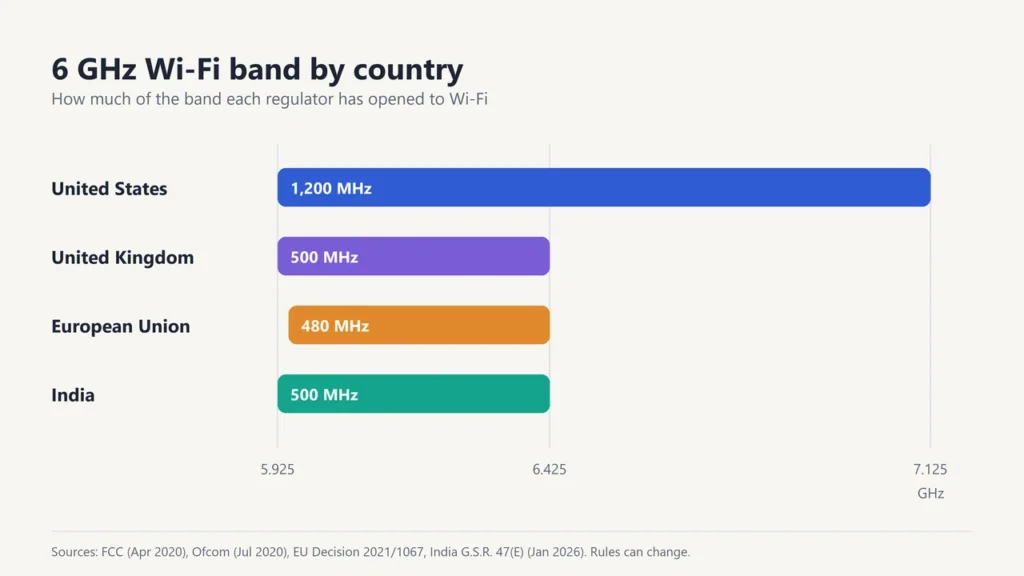
It depends on your country. Wi-Fi 6E and Wi-Fi 7’s 320 MHz channels need the 6 GHz band, and each country’s radio regulator decides how much of it Wi-Fi may use. Some countries opened the full band, some only the lower part.
| Country or region | 6 GHz range for Wi-Fi | Decided by |
|---|---|---|
| United States | 5.925-7.125 GHz (1,200 MHz) | FCC, 23 April 2020 |
| United Kingdom | 5.925-6.425 GHz (500 MHz) | Ofcom, 24 July 2020 |
| European Union | 5.945-6.425 GHz (480 MHz) | EU Decision 2021/1067, by 1 Dec 2021 |
| India | 5.925-6.425 GHz (500 MHz), low-power indoor and very-low-power outdoor use | Ministry of Communications, G.S.R. 47(E), January 2026 |
Rules keep changing. In July 2026, Ofcom said it plans to add the next 160 MHz (6.425-6.585 GHz) for Wi-Fi in the UK, but it was still consulting on the draft regulations at the time of writing. If your country hasn’t opened 6 GHz, a Wi-Fi 6E or Wi-Fi 7 router will still work on 2.4 GHz and 5 GHz, but without 320 MHz channels.
Will a Wi-Fi 7 router work with older devices?
Yes. The Wi-Fi Alliance’s certification seal covers backward compatibility, so a Wi-Fi 7 router still connects to Wi-Fi 6, Wi-Fi 5 and older devices. Each device just connects at the best level it supports. An older laptop won’t get Wi-Fi 7 features from a new router.
Should you upgrade from Wi-Fi 6 to Wi-Fi 7?
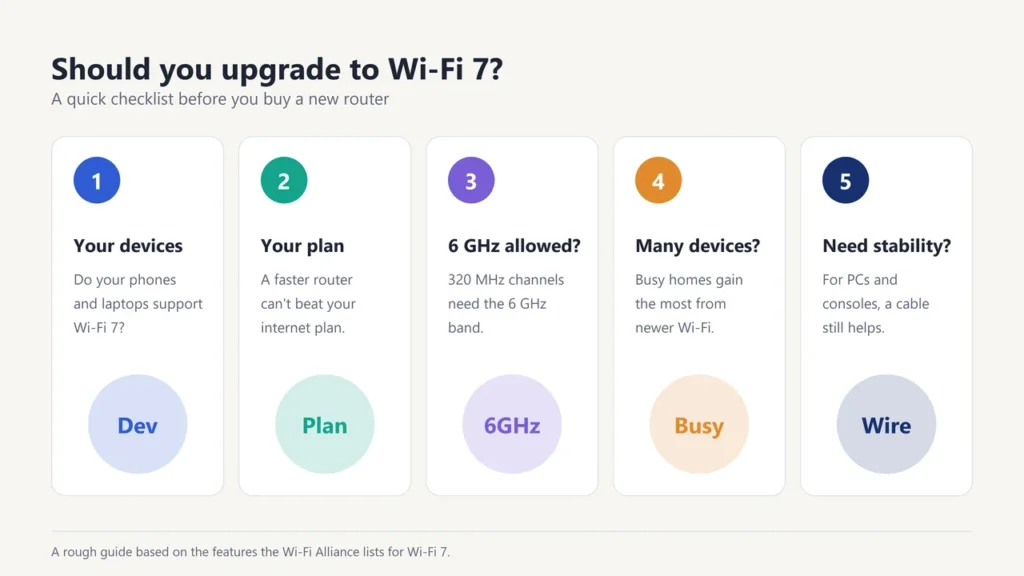
As a rough guide, upgrading to Wi-Fi 7 makes sense if most of these are true:
- Your newest phones, laptops or consoles support Wi-Fi 7
- Your internet plan is faster than about 1 Gbps, or you move big files inside your home
- Your country allows Wi-Fi in the 6 GHz band
- You have many busy devices, or your current router is old and struggling
Staying on Wi-Fi 6 makes sense if your devices are mostly Wi-Fi 6 or older, your plan is a few hundred Mbps, and your current network works well. If your problem is weak signal in far rooms, moving the router or adding a mesh system may help more than a new Wi-Fi generation. And for the most stable link to a desktop PC or games console, a cable still helps. See Wi-Fi vs Ethernet.
What comes after Wi-Fi 7?
Wi-Fi 8 is being developed now. The Wi-Fi Alliance lists Wi-Fi 8 (IEEE 802.11bn) as current work, focused on “ultra-high reliability”. The IEEE project, started in September 2023, aims for 25% more throughput and 25% lower delay in the slowest moments. There is no official launch date yet, so don’t wait for it if you need a new router today.
Whatever you choose, keep your network secure. Read how to know if your Wi-Fi is secure, and if you’re shopping, compare models in our best Wi-Fi routers list.
Frequently asked questions
What is the main difference between Wi-Fi 6 and Wi-Fi 7?
Wi-Fi 7 adds 320 MHz channels in the 6 GHz band, Multi-Link Operation (using several bands at once) and 4K QAM. Wi-Fi 6 tops out at 160 MHz channels and 1024 QAM, and uses one link at a time.
Is Wi-Fi 6E better than Wi-Fi 6?
It has the same features, plus access to the 6 GHz band, which is less crowded. That helps only if your devices support 6E and your country allows 6 GHz Wi-Fi.
Do I need a Wi-Fi 7 phone to use a Wi-Fi 7 router?
No, older phones still connect. But to get Wi-Fi 7 features such as MLO and 320 MHz channels, the phone must support Wi-Fi 7 too.
What is the maximum speed of Wi-Fi 7?
The Wi-Fi Alliance does not give one figure. It describes “multigigabit” speeds. The IEEE 802.11be standard was designed for a maximum throughput of at least 30 Gbit/s in lab terms. Real speeds at home are far lower and depend on your devices, distance and internet plan.
Is Wi-Fi 7 802.11be?
Yes. Wi-Fi 7 is the consumer name for products based on IEEE 802.11be (“Extremely High Throughput”). Wi-Fi 6 is 802.11ax, and Wi-Fi 5 is 802.11ac.
Does Wi-Fi 7 work without the 6 GHz band?
Yes. Wi-Fi 7 works across 2.4 GHz, 5 GHz and 6 GHz. The Wi-Fi Alliance says Wi-Fi 7 improves performance across the 2.4 GHz, 5 GHz and 6 GHz bands. Without 6 GHz, you lose the 320 MHz channels.

Justwebworld has published guides since 2012. How we write and update articles Report an error
