Note (October 2026): An earlier version of this article named the Hope Diamond and the Heart of Eternity as famous pink diamonds sold at auction; both are blue diamonds, and the claimed 2015 Christie’s sale could not be verified. The text has been corrected.
A pink diamond engagement ring is set with a natural, treated or lab-grown diamond with a pink body color. Natural pinks are rare and graded mainly on color intensity, from Faint to Fancy Vivid. The auction record is the 59.60-carat CTF Pink Star, sold for US$71.2 million in 2017. Always ask for an independent grading report.
Key Takeaways
- Color intensity drives value: Fancy Vivid pink is generally the most prized grade.
- The Argyle mine in Western Australia supplied most natural pink diamonds and closed in November 2020.
- The CTF Pink Star (US$71.2 million, 2017) is the most expensive gem sold at auction; the Williamson Pink Star holds the per-carat record.
- The Hope Diamond and the Heart of Eternity are blue, not pink.
- Treated and lab-grown pink diamonds cost less; a grading report should say which kind you are buying.
The colour pink is a symbol of love, and so is the diamond. What could be more romantic than a pink diamond engagement ring?
The overwhelming amount of choice when it comes to engagement rings can be quite daunting. It can be hard to know what a pink diamond really is, and in fact, what they are worth.
Pink diamonds are among the most valuable gems in the world: the 59.60-carat CTF Pink Star sold at Sotheby’s Hong Kong in April 2017 for US$71.2 million, which National Jeweler reports is still the highest price paid for any gem or jewel at auction. It is not, however, the only diamond graded for quality: like colorless stones, pink diamonds are graded for clarity from Flawless to Included, and only about 7% of pink diamonds are Flawless or Internally Flawless. Pink diamonds are genuinely rare: at the Argyle mine in Western Australia, historically the main source, only about 0.1% of the annual output was classified as pink.
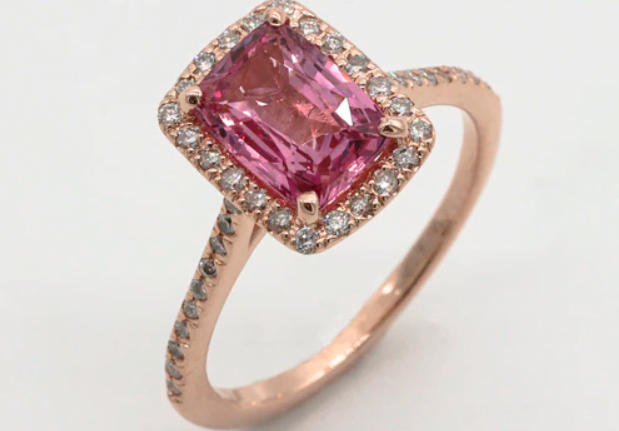
The often-repeated claim that only about six percent of diamonds ever reach the surface could not be confirmed against a reliable source. What is documented is the scarcity of supply: the Argyle mine, which produced roughly 80 to over 90 percent of the world’s pink diamonds, stopped mining in November 2020 after 37 years.
Choosing a pink diamond engagement ring can feel overwhelming at first, because color, intensity and price vary so widely.
This guide explains what a pink diamond is, how its color is graded, what the most famous pink stones sold for and what to check before buying one.
What’s A Pink Diamond?
A pink diamond is a natural diamond with a pink body color. Pink diamonds belong to the group known as fancy colored diamonds and are a sought-after choice in fine jewelry.
Natural pink diamonds come in hues ranging from brownish pink to purplish pink. Their color is most commonly attributed to plastic deformation of the crystal lattice while the diamond formed, not to heat treatment. Separately, pink color can be produced artificially by irradiation and annealing, and a treated stone should always be disclosed as treated.
Pink diamonds are very rare, although red diamonds are rarer still: of all colored diamonds, red is the rarest.
A pink diamond is valued mainly for the strength of its color rather than its sparkle, and an intense pink stone can be dramatically more valuable than a colorless diamond of similar size.
Pink diamonds hold the top auction records for diamonds. The Hope Diamond and the Heart of Eternity, often named in this context, are in fact blue diamonds: the 45.52-carat Hope Diamond was donated by jeweler Harry Winston to the Smithsonian Institution in 1958 and remains on permanent exhibition there, and the 27.64-carat Heart of Eternity is graded Fancy Vivid Blue by the Gemological Institute of America (GIA).
No record could be found of a 2015 sale of the Heart of Eternity for $2.6 million at Christie’s; De Beers, which bought the stone from the Steinmetz Group, never named the buyer when it sold it. The best-documented pink diamond sales are the CTF Pink Star (US$71.2 million, Sotheby’s Hong Kong, April 2017) and the 11.15-carat Williamson Pink Star (US$57.7 million, Sotheby’s Hong Kong, October 2022).
What Is The Color Scale Of Pink Diamonds?
With pink diamonds, the stronger and purer the color, the more valuable the stone usually is. Fancy Vivid pink is generally the most prized intensity, so the darkest stones are not automatically the most expensive. This also has an effect on the price, with a faint pink diamond costing less than a fancy dark pink diamond.
Below is the color scale as originally listed here. In GIA terminology the intensity grades are Faint, Very Light, Light, Fancy Light, Fancy, Fancy Intense, Fancy Vivid, Fancy Deep and Fancy Dark; words such as purplish or brownish describe the hue, not a separate grade.
- Faint Pink
- Light Pink
- Fancy Light Pink.
- Fancy Pink
- Fancy Intense Purplish Pink.
- Fancy Vivid Purple Pink.
- Fancy Deep Pink.
- Fancy Dark Pink.
To find out more about the color scale, visit Astteria.com.
Pink Diamonds As Engagement Rings
Despite the price, pink diamonds have become a popular option for engagement rings. Interest grew sharply after Ben Affleck proposed to Jennifer Lopez in 2002 with a 6.1-carat pink diamond ring.
Part of the appeal is visibility: a pink stone stands out from the colorless diamonds most people expect to see in an engagement ring.
When choosing a pink diamond engagement ring, start with color, because it matters more to value than clarity: compare the intensity grade and any hue modifier on the grading report. It is important to see the shade in person, and a specialist dealer such as Astteria can show stones of a similar shade side by side.
Many buyers consider pink diamonds especially beautiful, and the color pink is widely associated with love and romance, which adds to their appeal for engagement rings.
A pink diamond is also a distinctive choice: because natural pinks are scarce, a ring set with one is unlikely to look like anyone else’s. Buyers on a tighter budget can compare smaller stones, lighter intensities or laboratory-grown pink diamonds.
How Are Pink Diamonds Graded?
Pink diamonds are graded on the same four Cs as other diamonds (color, clarity, cut and carat weight), but color is the most important factor in a pink diamond’s value. A grading report from a laboratory such as the Gemological Institute of America (GIA) describes the color by hue, saturation and tone.
- Hue: pink, sometimes with a brown, orange or purple secondary hue (for example, purplish pink).
- Intensity grade: Faint, Very Light, Light, Fancy Light, Fancy, Fancy Intense, Fancy Vivid, Fancy Deep or Fancy Dark.
- Clarity: Flawless to Included; most pink diamonds are Slightly Included, and only about 7% are Flawless or Internally Flawless.
- Fluorescence: according to GIA, more than 80% of pink diamonds fluoresce.
The Argyle mine also used its own 1 to 9 pink color scale, where 1 is the darkest and 9 the lightest, and some Argyle stones carry both an Argyle grade and a GIA report.
Famous Pink Diamonds and What They Sold For
Auction results show why pink diamonds are treated as collector stones. The figures below are reported sale prices including fees.
| Diamond | Weight and color | Sale |
|---|---|---|
| CTF Pink Star (formerly Steinmetz Pink) | 59.60 ct, Fancy Vivid Pink | US$71.2 million, Sotheby’s Hong Kong, April 2017 |
| Williamson Pink Star | 11.15 ct, Fancy Vivid Pink, Internally Flawless | US$57.7 million, Sotheby’s Hong Kong, October 2022 (about $5.2 million per carat, an auction record per carat) |
| Sweet Josephine | 16.08 ct, pink | US$28.5 million, 2015 |
| Spirit of the Rose | 14.8 ct, purple-pink | US$26.6 million, Switzerland, November 2020 |
| Daria-i-Noor | about 182 ct, pink | Not sold; part of the Iranian crown jewels |
For more record-setting stones and rings, see the most expensive engagement rings in the world.
Where Do Pink Diamonds Come From?
Pink diamonds have been found in Australia, Brazil, Russia, South Africa and Tanzania, and the first known pink diamonds came from the Kollur mine in India. For decades the Argyle mine in the Kimberley region of Western Australia, operated by Rio Tinto, supplied most of the world’s pink and red diamonds; it closed in November 2020 after producing more than 865 million carats of rough diamonds.
New finds still occur. In July 2022 the Australian miner Lucapa Diamond Company reported a 170-carat pink diamond, named the Lulo Rose, from the Lulo alluvial mine in Angola, described as the largest pink diamond found in about 300 years.
Natural, Treated or Lab-Grown Pink Diamonds
A pink diamond engagement ring can be set with one of three kinds of stone, and the difference has a large effect on price.
- Natural pink diamond: color formed in the earth, mostly through plastic deformation of the crystal lattice. The rarest and most expensive option.
- Treated pink diamond: a natural diamond whose pink color was produced or enhanced in a laboratory, for example by irradiation and annealing. Treatment must be disclosed and is detectable by gemological testing.
- Lab-grown pink diamond: chemically the same as a mined diamond but grown by chemical vapor deposition (CVD) or high-pressure, high-temperature (HPHT) methods; the pink color is often added after growth. GIA issues separate reports for laboratory-grown diamonds.
For a fuller comparison of mined and grown stones, read this beginner’s guide to lab-grown diamonds.
How to Buy a Pink Diamond Engagement Ring
- Ask for an independent grading report (such as GIA) that states whether the color is natural, treated or laboratory-grown.
- Compare intensity grades rather than carat weight alone; a smaller vivid stone can cost more than a larger faint one.
- View the stone in daylight and next to other pinks, because hue modifiers such as brown or purple change the look.
- Choose a setting you like with the color. Rose gold is a popular match for pink stones, as explained in why rose gold engagement rings are popular.
- Buy safely and insure the ring. Check the seller’s return policy, follow these tips for buying jewelry online safely, and read what to know about jewelry insurance.
Prices for natural pink diamonds vary enormously with intensity, size and origin, so there is no reliable fixed price per carat; compare written quotes for graded stones. For the basics of choosing any diamond ring, see the complete guide to choosing a diamond engagement ring.
Frequently Asked Questions
Are pink diamonds real diamonds?
Yes. Natural pink diamonds are real diamonds whose pink color comes mainly from distortion in the crystal lattice formed deep in the earth. Treated and laboratory-grown pink diamonds also exist, so a grading report should state which kind a stone is.
What is the most expensive pink diamond ever sold?
The most expensive pink diamond sold at auction is the 59.60-carat CTF Pink Star, which sold for US$71.2 million at Sotheby’s Hong Kong in April 2017. The 11.15-carat Williamson Pink Star holds the record price per carat, about $5.2 million, from October 2022.
Is the Hope Diamond pink?
No. The Hope Diamond is a 45.52-carat blue diamond. It is on permanent display at the Smithsonian’s National Museum of Natural History in Washington, D.C., after Harry Winston donated it in 1958.
Why are pink diamonds so rare?
Pink diamonds are rare because only a tiny share of mined diamonds are pink: at the Argyle mine, the main historical source, about 0.1% of output was pink. Argyle closed in November 2020, further limiting new supply.
Which pink diamond color grade is best?
Fancy Vivid is generally the most prized pink intensity grade, and a pure pink hue is usually valued above pinks with brown or orange modifiers. Purplish pink stones are also highly regarded.
Are lab-grown pink diamonds cheaper?
Laboratory-grown pink diamonds are made by CVD or HPHT methods and are generally a lower-cost alternative to natural pinks. Prices vary by seller, so compare graded stones and confirm the report identifies the diamond as laboratory-grown.