

Global logistics is the planning and management of how goods, information and payments move across national borders, from raw-material suppliers and factories to the final customer. Global logistics combines international transport by sea, air, rail and road with warehousing, inventory control, customs clearance and trade documentation, so that products arrive on time, intact and at an acceptable cost.
Key Takeaways
- Global logistics covers international transport, warehousing, inventory, customs and the information that ties them together.
- According to the WTO, world merchandise exports were worth US$26.26 trillion in 2025, up 7% on 2024.
- Ships carry the large majority of world trade by volume; UNCTAD puts seaborne trade at 12,720 million tons in 2024.
- Incoterms 2020, published by the International Chamber of Commerce, define who pays for and bears the risk of each stage of an international shipment.
- Many businesses outsource global logistics to third-party (3PL) or fourth-party (4PL) providers rather than running it in-house.
When you want to create a great supply chain for your business, the primary focus is to have the right production facility. At the same time, you also need to focus on the critical movement of products across the globe and the logistics it takes to ensure they are delivered intact and safely.
Relying on comprehensive logistics software designed by top logistics software company CartonCloud can help a business identify cost-effective changes in its logistics operation, although results depend on the business and on how well any system is implemented. In this article, we will explore what global logistics is and how it benefits the world at large.
Because economies are now globalized and competition is intense, businesses need a dependable international logistics network, and they need to understand how global logistics works as international markets grow.
How well a company adapts its logistics to a changing trading environment is one of the key business questions of the twenty-first century.
What is global logistics?
The first thing to keep in mind at this stage is the fact that logistics and distribution were not entirely new concepts, and that some trade decisions that are now widely accepted are far from being what could be called “contemporary”.
In the early 1960s, Peter Drucker, the management writer, drew attention to the field: in 1962 he described physical distribution as the American economy’s “dark continent,” an area of business that was poorly understood despite its importance. That observation is widely credited with marking the start of an era of major advances in logistics management, covering transportation, inventory control, order processing, materials handling and warehousing.
Global logistics is the system that connects the critical parts of an international supply chain, from the factory where goods are made to the point where they are consumed. Global logistics matters because it keeps distribution reliable all the way from the production facility to the consumer.
Thanks to global logistics, we get to have the luxury of goods flowing to us all from nearly every part of the world, and we can easily access all the necessary items we need to fulfill our requirements at all times.
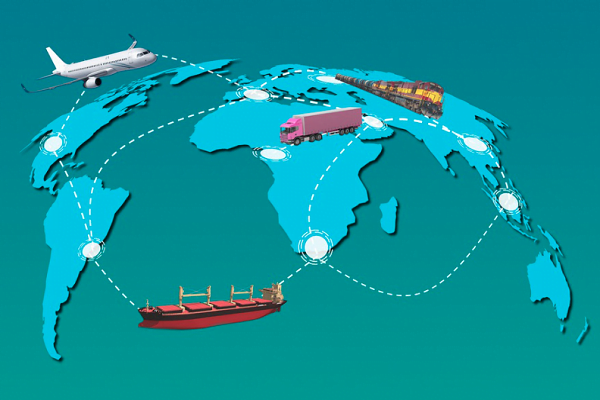
One thing to note about global logistics is that it needs to rely on a variety of methods to reach customers. That means you will find global logistics solutions using planes, ships, trains or trucks in order to meet global demands and arrive in a timely manner.
How modern global logistics developed
Some logistics histories label the period that began around 1965 as “The Maturing Years of Material Handling and Physical Distribution.” The emphasis placed on customer service during this period was the most important factor, in addition to the fact that physical distribution managers began to have a voice in inventory decision making.
Also in this period, the integration of material handling occurred, the need to coordinate the movements of products and information both within its own limits and outside them was recognized, and the result was a more effective organizational structure with a greater capacity to respond.
Global Logistics in the future
There are several specific areas in which the “logistics of the future” can be distinguished from the logistics of the past and present.
The first can be differentiated by the application of the topic of “quality” and the importance that quality management has in global logistics efforts, such as “get it right the first time” or “zero defects”.
The second is the advance in the ability to integrate the concepts of “time” and “space”, since these concepts have been considered separately and not together.
The third point is related to the great opportunities that the international context will offer in this discipline, since progressive companies are looking for other ways to increase their strength through appropriate international business relationships.
Fourth is the change in emphasis that will be placed on the consideration of “logistics attributes” rather than on making direct reference to “specific logistics services.”
As a fifth point, the emergence of external entities, since in the logistics function there is now a growing interest in using third parties to take care of everything related to the distribution of the company.
Global logistics needs technological support
Top logistics companies use tools like warehouse and transport management systems, AI, robotics and machine learning ensuring that products and processes run lean and deliver more efficient results with fewer human errors.
With the support of key logistics technology and software global logistics and global supply chains are functioning at a far more sophisticated level than ever before in human history.
During the COVID-19 pandemic that began in 2020, many logistics companies that had not adopted and integrated advanced technology systems lost work, customers and in extreme cases even their businesses as they were having to compete with companies that were already well positioned to handle a crisis with the support of key technology.
Why is global logistics such a powerful, in-demand industry?
There are multiple reasons that drive demand and growth for the logistics industry. Supply chains are always rapidly evolving and growing as a result. Beyond the impact of globalization, the rise of e-commerce keeps pushing the logistics sector to move faster and build better, more efficient systems to meet customer expectations around the world.
And yes, there’s a huge focus on consumerism. People are always looking for the best, next product, and global logistics is one of the key components in making that a reality. Consumer demand is one of the main reasons the global logistics industry keeps changing.
Benefits of outsourcing global logistics
E-commerce, globalized consumption and the expectation of fast purchases and deliveries make an efficient logistics service increasingly essential. Modern businesses need logistics capacity that covers every area of the company while also raising productivity.
Outsourcing logistics functions to a third-party logistics (3PL) provider is one way to achieve this. Choosing a provider with the right regional coverage, responsive service and fast options for urgent shipments helps a business get the efficient logistics service it needs.
Cost reduction
Hiring a logistics company can save costs on functions the business would otherwise have to run itself, such as warehousing, transport management and customs paperwork. That frees the business to concentrate on its core activities and overall productivity.
Better service for customers
Modern parcel and logistics providers are built for speed and efficiency, which helps shipments reach customers reliably. Many also offer customized service, such as tracking updates and delivery options.
Higher service quality
An efficient logistics service reduces errors such as wrong, late or damaged deliveries. That raises the quality of service a business offers and helps it deliver products in the way its customers expect.
Take advantage of the operators’ distribution network
Logistics operators offer extensive national or international networks. Using those networks can help a business operate more effectively across borders without building its own.
Access to advanced systems
A strong logistics provider has capacity for express delivery and uses advanced systems, such as warehouse and transport management software and shipment tracking, that the business can benefit from.
Selecting the right logistics provider
A logistics provider should specialize in the areas the business needs and have enough experience to meet its customers’ expectations. It is usually better to choose an operator that already serves other businesses in the same sector.
How does global logistics work?
Global logistics follows the same basic sequence for most international shipments, whatever the product. Each step produces documents and data that the next step depends on.
- Sourcing and inbound logistics: materials, parts or finished goods are bought from suppliers and moved to factories, warehouses or stores.
- Agreeing trade terms: buyer and seller choose an Incoterms rule that sets who pays for transport and insurance and where risk passes from one to the other.
- Packing and documentation: goods are packed, labeled and listed on a commercial invoice and packing list, and classified with a customs tariff code.
- Export clearance and main transport: goods clear export customs and travel by ship, aircraft, train or truck, often in containers that can move between modes.
- Import clearance: the importer or a customs broker declares the goods and pays any duties and taxes due in the destination country.
- Warehousing and outbound logistics: goods are stored, picked, packed and delivered to the end customer.
- Reverse logistics: returns, repairs and recycling flow back up the chain. Read more in our guide to handling common reverse logistics issues.
For the wider picture of how these steps fit into planning and procurement, see what logistics and supply chain management are.
What are the main modes of international transport?
Global logistics uses four main transport modes, and many shipments combine two or more of them (intermodal transport). Standardized shipping containers let cargo transfer between ship, rail and truck without being unpacked.
| Mode | Relative cost | Relative speed | Typical use |
|---|---|---|---|
| Sea (container and bulk ships) | Lowest for long distances | Slowest | High-volume goods, raw materials, most containerized trade |
| Air freight | Highest | Fastest over long distances | Urgent, high-value or perishable goods |
| Rail | Usually below air and often below road | Moderate | Heavy goods and containers over land corridors |
| Road (trucks) | Above sea, below air | Moderate; flexible door-to-door | First and last mile, regional cross-border trade |
Sea freight dominates global logistics by volume. According to UNCTAD’s Review of Maritime Transport 2025, maritime trade reached 12,720 million tons in 2024, up 2.2%, and UNCTAD expected seaborne trade to grow by only about 0.5% in 2025. UNCTAD also estimates that around 80% of world trade by volume moves by sea. For more on the shipping side, see the future of sea freight services.
How big is global trade?
Global logistics supports trade worth tens of trillions of dollars a year. According to the World Trade Organization’s Global Trade Outlook and Statistics (March 2026), the value of world merchandise exports was US$26.26 trillion in 2025, up 7% compared with 2024, and services trade reached US$9.56 trillion. In volume terms, the WTO reported merchandise trade growth of 4.6% in 2025 and, in its baseline scenario, forecast a slowdown to 1.9% in 2026.
What are Incoterms and why do they matter?
Incoterms are standard trade rules published by the International Chamber of Commerce (ICC) that define the responsibilities of buyers and sellers in an international sale. The current edition, Incoterms 2020, contains 11 rules.
- Rules for any mode of transport (7): EXW, FCA, CPT, CIP, DPU, DAP and DDP.
- Rules for sea and inland waterway transport only (4): FAS, FOB, CFR and CIF.
The sea-only rules are generally considered unsuitable for containerized cargo and other combined transport. Choosing the wrong rule can leave a business paying for transport or carrying risk it did not expect. Cargo insurance terms matter too; see our explainer on the warehouse to warehouse clause in marine insurance.
How do customs and HS codes fit in?
Every internationally traded product is classified under the Harmonized System (HS), maintained by the World Customs Organization in Brussels. The HS code is six digits long, and countries often set duties at an 8-digit level, sometimes adding statistical suffixes up to 10 digits. More than 200 countries and economies apply the Harmonized System, and the current edition, HS 2022, took effect on 1 January 2022. A correct HS code determines the duty rate and any import rules, so misclassification can cause delays and extra costs.
3PL vs 4PL: what is the difference?
A third-party logistics (3PL) provider runs logistics operations for a client, such as warehousing, pick and pack, transportation, tracking and order fulfillment. A fourth-party logistics (4PL) provider is usually non-asset-based: it selects, coordinates and optimizes 3PLs on the client’s behalf.
| Aspect | 3PL | 4PL |
|---|---|---|
| Role | Performs logistics tasks | Selects and integrates logistics providers |
| Assets | Often runs warehouses or transport | Usually non-asset-based |
| Suits | Businesses outsourcing specific operations | Businesses with complex, multi-provider supply chains |
How to choose a global logistics provider
- Coverage: check that the provider serves your origin and destination countries and the transport modes you need.
- Sector experience: look for experience with your product type, such as perishables, hazardous goods or high-value items.
- Customs capability: confirm whether the provider handles customs brokerage and HS classification or works with a broker.
- Visibility: ask what shipment tracking and reporting you will get.
- Warehousing: compare storage, fulfillment and inventory services; see our tips on making a warehouse more efficient and on why inventory management matters.
- Costs and terms: get written quotes that state what is included, which Incoterms rule applies and who carries insurance.
Frequently Asked Questions
What is the difference between global logistics and supply chain management?
Global logistics is the part of supply chain management that moves and stores goods across borders. Supply chain management is broader: it also covers sourcing, procurement, production planning and supplier relationships.
What are the main types of logistics?
The main types are inbound logistics (moving materials from suppliers to production), outbound logistics (storing and delivering finished products to customers) and reverse logistics (handling returns, reuse and disposal).
Which transport mode carries most international trade?
Sea transport carries most international trade by volume. UNCTAD estimates that around 80% of world trade by volume moves by sea, and maritime trade reached 12,720 million tons in 2024.
Who publishes Incoterms?
Incoterms are published by the International Chamber of Commerce (ICC). The current edition is Incoterms 2020, which has 11 rules: seven for any mode of transport and four for sea and inland waterway transport.
What does a 3PL do?
A third-party logistics (3PL) provider handles outsourced logistics work for a business, such as warehousing, pick and pack, transportation, tracking and order fulfillment.

Justwebworld has published guides since 2012. How we write and update articles Report an error
